

AT&T posted what it called its best consolidated service revenue growth in more than four years on 21 October 2026. Revenue rose 5.3% to $32.3 billion (B), and AT&T raised its 2026 outlook for adjusted earnings per share (EPS). In the same quarter it took a charge of roughly $800 million (M) for employee separations. Chief financial officer Pascal Desroches told analysts it “will impact cash primarily in 2027,” according to the call transcript.
AT&T isn’t cutting because business is bad. It is cutting while business is on the upswing. While AI is widely viewed as a job killer, that’s not necessarily true in telecom. AT&T now cites its shift from copper to fiber as the main enabler.
AT&T credited AI with its savings in February, but cited retirement in October
CEO John Stankey set out the savings plan in his February 2026 shareholder letter. AT&T, he said, planned “an additional $4 billion in annual cost savings by the end of 2028 as we leverage AI.” Digital customer transactions and operating leverage came second and third.
On the 21 October call, CFO Desroches repeated the $4B target, but pinned it to the old network instead. “Copper retirement remains an integral part of our overall cost transformation,” he said. Neither executive linked AI to costs, headcount or the separation charge. Stankey’s references to AI were focused on demand. The fiber network, he said, “has us well positioned to be a leader in AI-grade connectivity.” The results release mentions AI once, in his line that “our asset base positions us well for the AI era.”
AT&T does use AI as a tool to reduce its own costs, but has not quantified the savings. It has, however, talked about how it keeps its AI costs down. Chief Data and AI Officer Andy Markus wrote in July that AT&T runs an average of 45 billion tokens a day, which can be a significant expense. Its AI Gateway, he said, is “reducing AI costs as much as 90%, already saving millions.” Markus explained that it does this through an “intelligent, cache-aware routing and governance system that acts as a control layer for all artificial intelligence requests across the company.”
The workforce has halved while AT&T moved from copper to fiber
AT&T employed 130,870 people in 2Q26, 49% fewer than the 256,420 it had at the end of 2011, according to MTN Consulting’s Telco Workforce Monitor. It cut 7,960 jobs in 2025 and another 2,160 in 1H26. It has fiber passing 32 million locations and aims to pass more than 60 million by the end of 2030, according to its 2025 Sustainability Update.
Copper has come up on every AT&T call this year. In January, Stankey said AT&T had stopped selling legacy copper services in 85% of its wire centers, and Desroches said AT&T aims to discontinue a large majority of copper-based services by the end of 2029. In July, Stankey described an orderly turndown of legacy copper services by the end of the decade. Like most telcos, AT&T doesn’t tie any of this to a job count. BT is a similar case, as we showed in a recent post. Deploying more fiber deep in the access network reduced BT’s network faults, and that has supported a smaller Openreach workforce. Like AT&T, though, BT has yet to put a number on what AI saved.
AT&T doesn’t report personnel expenses, and neither do most US telcos. MTN Consulting estimates AT&T’s labor cost from the ratio of its CEO’s pay to its median employee’s pay, plus US Bureau of Labor Statistics (BLS) pay data for the telecom sector. On that estimate AT&T spent $4.8 billion (B) on labor in 2Q26. That works out to $143,300 per employee over the four quarters to 2Q26, 1.8 times the $79,300 average across 40 telcos in the Americas. Revenue per employee is higher too, though, at $972,300 against $619,800.
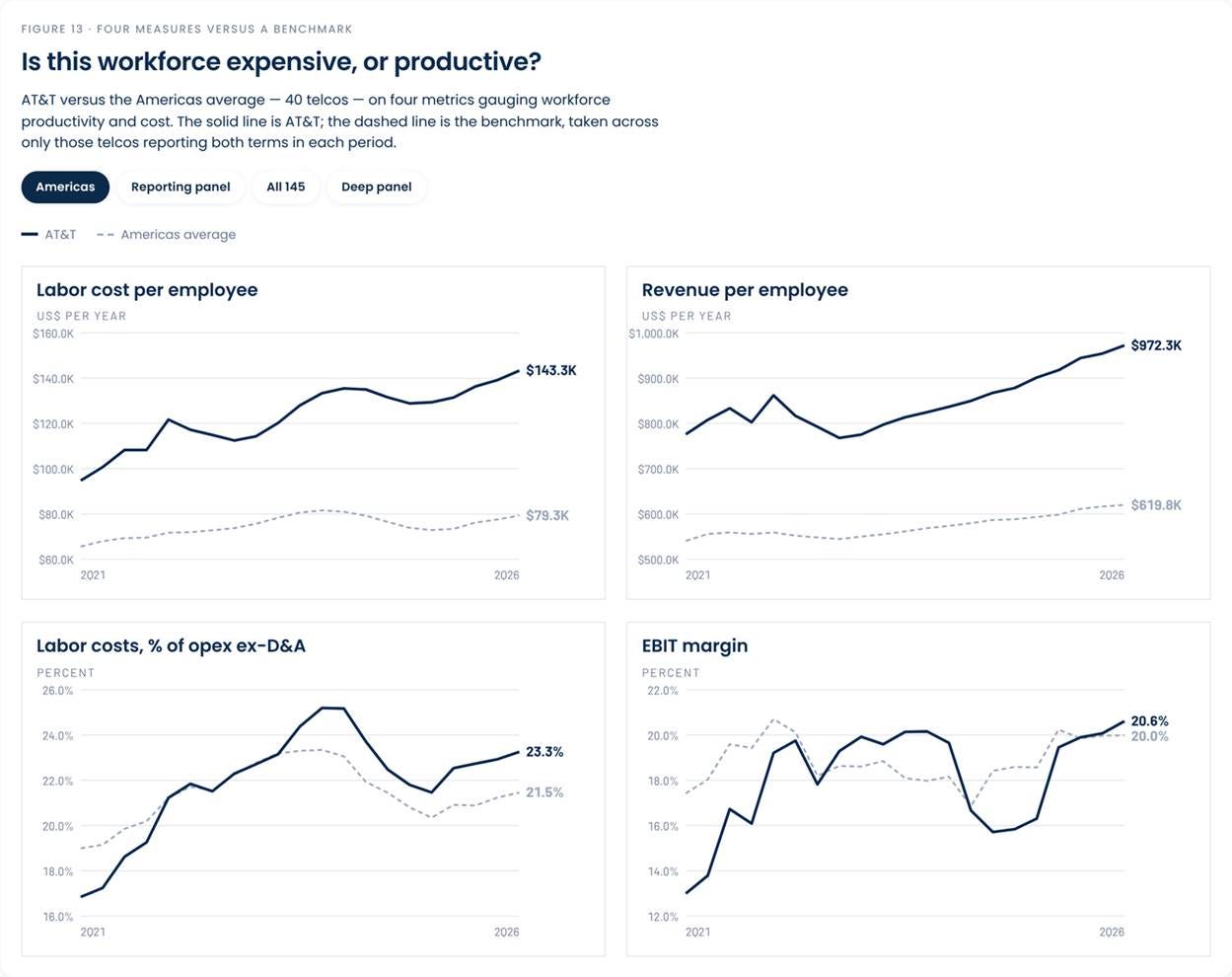
Source: MTN Consulting’s Telco Workforce Monitor, Figure 13, AT&T versus the Americas average (40 telcos), 2Q21 to 2Q26, annualized, US dollars. AT&T labor cost is an MTN Consulting estimate.
AT&T gives no job count for the $800M
AT&T hasn’t said how many people the charge covers. Its 10-Q describes separation charges only as costs “associated with voluntary and/or strategic offers,” and neither the release nor the call gives a number of employees impacted. For scale, $800M is about a sixth of our estimate of what AT&T spent on labor in 2Q26.
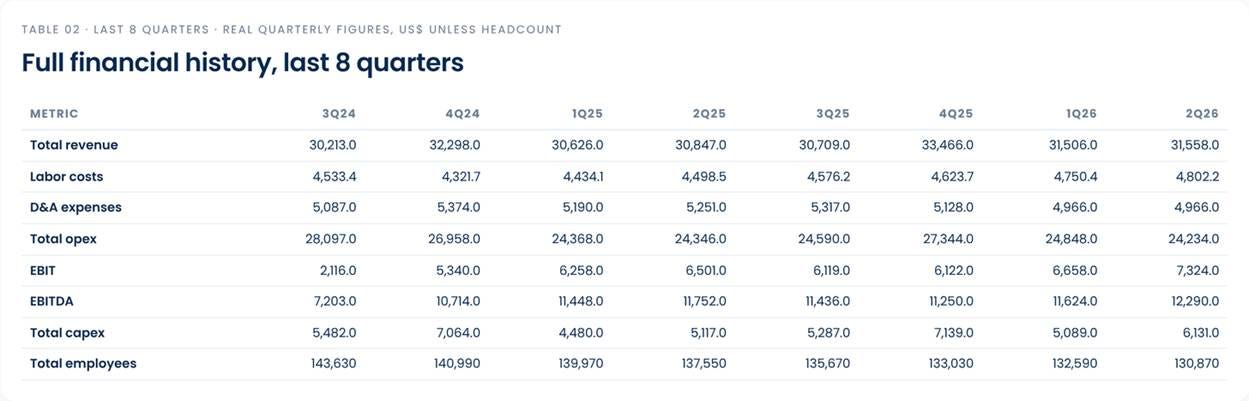
Source: MTN Consulting’s Telco Workforce Monitor, AT&T, Table 02, real quarterly figures, US$ millions except employees. Labor cost is an MTN Consulting estimate.
The fiber switch also cuts AT&T’s power bill
Fiber needs less electricity than copper, and AT&T addresses this in its 2025 Sustainability Update. It reports saving 660,000 megawatt-hours (MWh) since 2024 by moving its network from copper to fiber. For the five-year period from 2024 through 2028, AT&T expects the fiber transition to reduce energy use by 1.06 million MWh and its emissions by about 740,000 metric tons of carbon dioxide equivalent (CO2e). AT&T’s total energy use, by its reported KPIs, was 15.0 million MWh in 2025, up from 14.8 million MWh in 2024. The fiber shift may not necessarily result in lower energy consumption, though: AT&T says the AI era “will also drive increased power usage.”
AT&T will also spend $1B a year less on its network
AT&T also talked about capex projections on its recent call. The company now expects capital investment of $22B to $23B a year in 2027 and 2028, down from the $23B to $24B it guided in July. Desroches said $300M to $400M of the reduction comes from selling AT&T Mexico’s wireless business. “The balance is from the efficiencies I described,” he said.
AT&T’s quarterly headcount, revenue, capex, labor cost and profit since 1Q11 sit in the Telco Workforce Monitor, alongside the same series for MTN Consulting’s 145-telco universe. Headcount, revenue and capex are free to explore with registration. Full labor-cost and profit history for the 72-telco panel, including the AT&T charts above, is $799 as a one-time purchase of one edition.
Questions about this post? Contact the author: Matt Walker, Chief Analyst of MTN Consulting (matt@mtn-c.com)
Interested in exploring (some of) the data behind MTN Consulting’s telco AI coverage? Check out our Telco Workforce Monitor, which tracks headcount, labor costs, profitability and AI adoption at 145 telcos: