

In May 2023 BT announced a plan to shrink its workforce by up to 55,000 by the end of the decade. Philip Jansen, then BT’s chief executive, put about 10,000 of that down to “automated digitization” and said BT would be “a huge beneficiary of AI.” A BT spokesperson said those roles would most likely be in customer services. BT also said that, of 40,000 cuts at the low end of its range, 15,000 would be engineers who build the fiber network. Another 10,000 would maintain copper and fiber, and 5,000 would come from other functions.
Three years on, BT expects the cuts to land at the top of its range, 50,000 to 55,000. Most have little to do with AI. BT’s chief financial officer, Simon Lowth, said the highest reductions in direct labor were in Openreach, its network arm, and Corporate Functions. In Openreach, BT ties the cut to fewer faults, which follow from the well-known lower maintenance requirements of full-fiber access networks.
“Faults across fibre and copper reduced by a record 18%. This helped us cut direct labour by more than 10%.” -CEO Allison Kirkby, on FY26 earnings call.
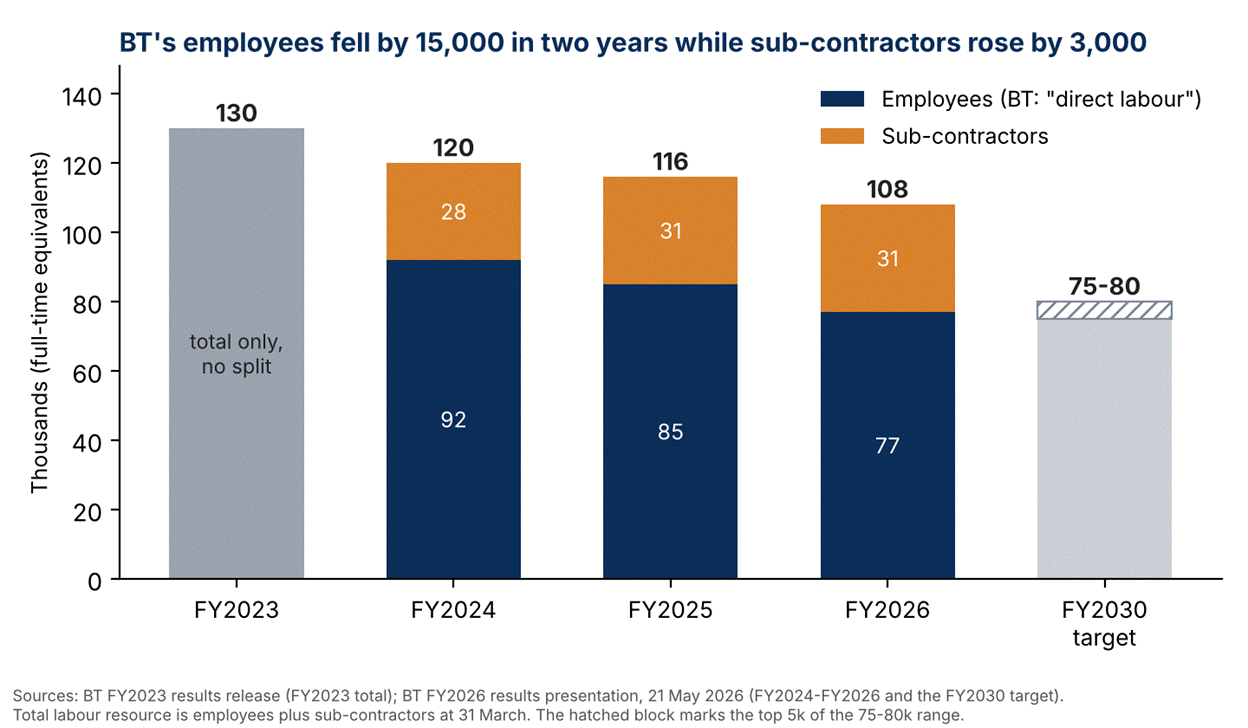
BT has cut 22,000 people since 2023 while leaning more on sub-contractors
BT counts its workforce as “total labour resource”: its own employees plus sub-contractors. That figure stood at 130,000 when BT set its target in its FY2023 results (BT’s fiscal year ends 31 March). The goal was 75,000 to 90,000 by FY2028-FY2030. By March 2026 it was 108,000. That’s 22,000 fewer, or 17%.
The split between employees and contractors matters. Between FY2024 and FY2026, BT’s direct labor fell from 92,000 to 77,000 while sub-contractors rose from 28,000 to 31,000. Sub-contractors now make up 29% of the workforce, up from 23%. In its FY2025 call, CFO Simon Lowth said the 6,400 drop in employees was “partially offset by a 2,400 increase in lower unit cost and more flexible subcontractors.” MTN Consulting’s Telco Workforce Monitor counts employees only, so it follows BT’s direct labor and not its total labor resource: at the end of March 2026 it shows 77,152, against 77,000 from BT. From 2Q22 to 2Q26, it shows BT’s headcount down 24.1%, from 99,087 to 75,226, against a median fall of 6.9% across 72 telcos.
Openreach is where jobs disappeared, and fiber is the cause
BT’s executives say plainly where the cuts came from. In the FY2026 presentation transcript, CEO Allison Kirkby said faults across fiber and copper fell “a record 18%,” which “helped us cut direct labour by more than 10%” at Openreach. Lowth said direct labor fell in every unit, “with the highest in Openreach and Corporate Functions.” Fiber has “60% fewer faults than copper,” Kirkby said. Fewer faults means fewer engineers sent out to fix them.
The pattern was the same a year and a half earlier. In November 2024, Kirkby said most of the reduction “was in Openreach and Business, thanks to fewer faults on fibre and continued transformation.” She added a second reason: “the smart use of technology.” Lowth said Openreach had “around five thousand fewer FTE” (full-time equivalents) over the previous 12 months.
The next round follows the same logic. BT narrowed its FY2030 target in May 2026 to the low end of the range, 75,000 to 80,000, another 28,000 to 33,000 people. Lowth listed four areas for getting there. The first, he said, is “Openreach workforce reshaping post the fibre build ramp down.” BT expects repair volumes to fall from 2.4 million in FY2026 to 1.7-2.1 million by FY2030 as customers move off copper.
BT talks about AI savings but hasn’t put a number on them
The point is not that AI has no impact on job cuts. It does, and that may grow over time. The point is that these things are hard to measure, and many things are changing simultaneously – such as the completion of fiber-to-the-home builds. It’s been widely understood for at least a couple of decades that a fully fiberized access plant would bring with it lower staffing requirements. Jansen said as much on a 2023 investor call: “When we stop building the network we won’t need that workforce.”
BT’s executives still lean on AI when they talk about the future workforce. Kirkby told the Financial Times in June 2025 that earlier headcount plans “did not reflect the full potential of AI” and that BT might be “even smaller” by 2030. In May 2026 she said AI’s “early results are encouraging,” and pointed to call centers where AI helps advisers serve customers and cross-sell. She called AI “further upside” for a simpler business.
None of that came with a figure. Across BT’s FY2026 results presentation and transcript, no saving, call reduction or headcount number is attributed specifically to AI, including the £580 million of gross annualized savings it reports for FY2026. It’s probably not even possible. The closest BT has come was in November 2024, when Kirkby said “digital transformation also delivered tens of millions in savings” in the half, alongside fewer software applications and an AI chatbot. Kirkby gave network decommissioning the same “tens of millions.” BT reported £433 million of gross annualized savings for that half, meaning cost cuts counted at a full-year rate. If “tens of millions” means under £100 million, digital transformation, which includes the chatbot, supplied under a quarter of it.
The timing does favor AI. Eleven months after Kirkby said AI might make BT “even smaller,” BT cut the top of its FY2030 range from 90,000 to 80,000. AI may account for some of that change. BT hasn’t said how much.
Until it does, anyone counting telco jobs lost to AI should count most of BT’s as lost to fiber, a one-time network upgrade that needs fewer engineers to keep running. Telcos that moved their customers off copper years ago can’t repeat it.
*
Methodology
BT’s “total labour resource” includes employees and sub-contractors, measured as full-time equivalents at fiscal year end (31 March). FY2024-FY2026 figures come from BT’s FY2026 results presentation, and the 130,000 FY2023 baseline from its FY2023 results release. The Telco Workforce Monitor series counts employees only, so it matches BT’s direct labor but is lower than “total labor resource”. The 10,000 roles tied to digitization and AI, and the 15,000, 10,000 and 5,000 figures for fiber build, maintenance and other functions, come from Philip Jansen and BT statements to The Register in May 2023. The Monitor’s BT figures between BT’s reported dates, including 2Q26, are MTN Consulting estimates. The 6.9% median covers the 72 telcos with data in both 2Q22 and 2Q26. BT publishes no headcount by unit, so the shares of its actual cuts due to fiber and to AI are not reported.
About Gen AI Telco
The Gen AI Telco Substack is published by MTN Consulting LLC. Founded in 2017, MTN Consulting is a boutique advisory firm focused on telecom and hyperscale markets. We work with companies, investors, and policymakers on AI transition topics. Clients, soon-to-be clients, and journalists, feel free to contact us with any questions: Chief Analyst Matt Walker.