

Three Asian telcos announced token-based service offerings in the space of eight days this month. Singtel’s RE:AI unit launched one on 1 October, SK Telecom unveiled a plan on 8 October, and Indosat Ooredoo Hutchison launched one with F5 on 9 October. A token is the unit AI models use to meter and price text.
Telcos are eager for new revenue streams, and AI is today’s hot market, so it’s not a surprise to see the telco push. But most of what the telcos are selling here is someone else’s AI product. Each telco is building a switchboard, in essence, which will provide one contract, one bill and a routing layer that sends each prompt to the model that fits best. The telcos’ pitch is the wrapper, and this is where they hope to reap good margins.

Singtel resells Anthropic and OpenAI under one contract
RE:AI, the sovereign AI cloud business inside Singtel’s Digital InfraCo, calls its product AI Token-as-a-Service (TaaS). The launch release says that open-weight models such as Qwen, Mistral, GLM, Kimi and MiniMax are running on RE:AI’s own infrastructure. The product page adds that closed-weight models “from Anthropic, OpenAI, Bedrock and Azure” are resold under one contract and billed per token, “with our margin applied.”
The telco’s main value add is the routing functionality. TaaS “automatically matches workloads to the most suitable AI models to optimize cost and performance,” according to the release. Sensitive work stays on Singtel’s sovereign infrastructure in Singapore, and less sensitive work can go to non-sovereign clouds. RE:AI already rents out graphics processing units (GPUs) through a GPU-as-a-Service offer. Adding on a token business moves Singtel one layer up, from renting hardware to brokering models. RE:AI promises token-level visibility into usage. Buyers should check that it also shows why each request went to the model it did, because the telco earns different margins on different models.
Indosat puts an in-country model on the same switchboard
Indosat’s Intelligence Suite offers more than 300 open and closed models through one interface. Its catalog lists Claude Sonnet 5, Gemini 2.5 Pro, DeepSeek-V3.2 and Llama 4 Maverick beside Sahabat-AI, a model it hosts in-country. Customers buy tokens as credits and spread them across models, applications and teams.
US-based vendor F5 provides the traffic management function, including load balancing that steers requests across GPUs. Indosat’s top tier is a dedicated private instance with “in-country processing and reserved capacity.” Indosat is targeting 50 businesses at launch, according to the F5 release.
SK Telecom plans to build a token gateway
SK Telecom is a step behind Singtel and Indosat: it has a plan but no product. Chief executive Jung Jae-hun told staff at an 8 October town hall that the company will build a Token Gateway. SK Telecom describes it as a control center that tracks how companies and customers use AI and connects them to the best-suited model and infrastructure.
SK Telecom’s competitive edge in this setup is billing, not AI models, and most telcos can claim the same edge. The gateway will build on about 23 million subscribers and SK Telecom’s existing payment system. China Mobile already lets Shanghai customers pay for tokens through their phone bills, China Daily reported in May. Singtel and Indosat already bill the enterprises they are targeting. SK Telecom’s plan stands out for aiming at consumers as well as companies. Integrated billing from a known entity lowers the friction of a first purchase, even if it doesn’t raise the cost of leaving.
China’s telcos show what a token switchboard costs
China Telecom launched trial token packages on 17 May, and China Mobile and China Unicom followed. China Telecom’s consumer plans amount to $0.09 to $0.15 per million tokens and its business plans at $0.30 to $0.40. China Mobile charges about $0.37 per million tokens in Beijing and Shanghai, according to the same report. China Mobile’s platform connects more than 300 mainstream AI models, including DeepSeek, Qwen, Doubao and GLM.
Comparing China Mobile’s prices to the list prices of the AI model companies is illuminating. Anthropic lists Claude Sonnet 5 at $2 per million input tokens and $10 per million output tokens, the same model Indosat offers. China Mobile’s $0.37 is less than a fifth of Anthropic’s input price and under a 25th of its output price. Its packages don’t split input from output, and a token isn’t a fixed unit: each model family splits text its own way. The gap mostly reflects the models. Qwen and DeepSeek are open-weight models, while Claude Sonnet 5 is a frontier model. China’s packages also hint at how tokens end up when telcos sell them as a utility: in monthly buckets, priced like data.
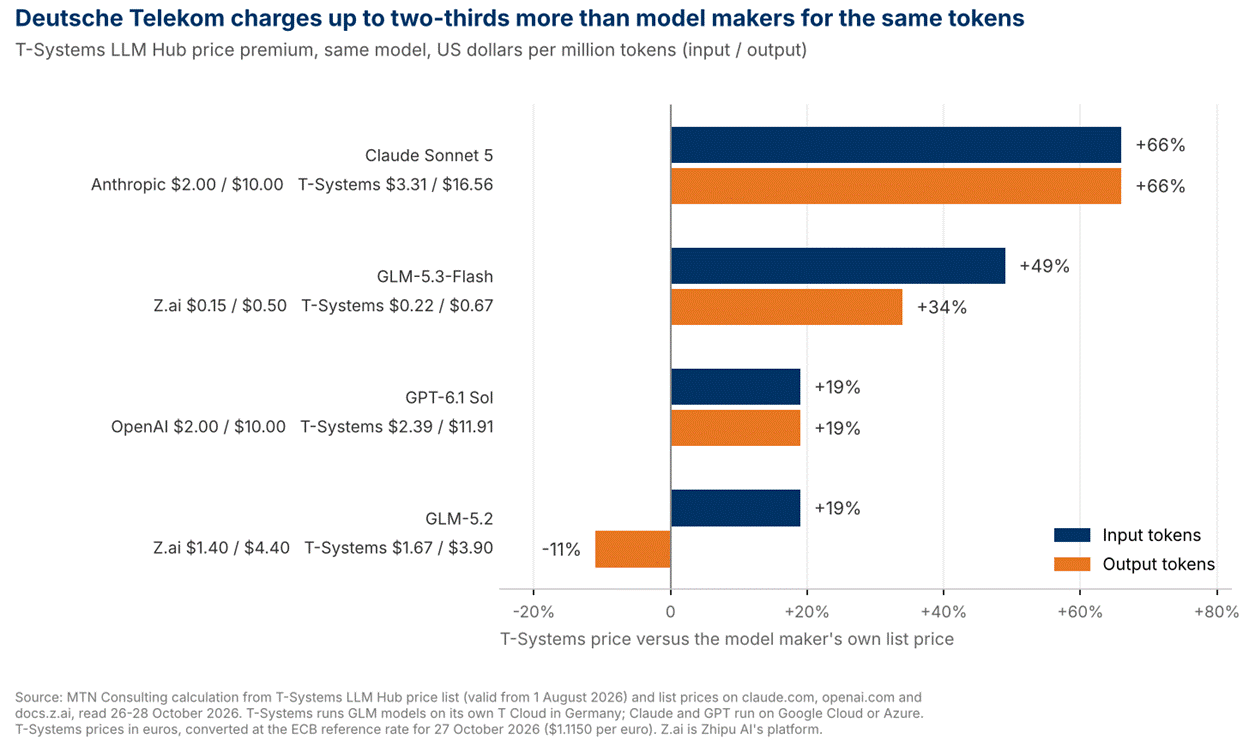
T-Systems, Deutsche Telekom’s IT services arm, publishes a price for each model it resells, which allows a like-for-like check. For Claude Sonnet 5 it charges $3.31 per million input tokens and $16.56 per million output tokens, about two-thirds above Anthropic’s own list price. Its rate for OpenAI’s GPT-6.1 Sol, which it resells from Microsoft Azure, is 19% above OpenAI’s. For Zhipu’s GLM-5.2, which T-Systems runs in Germany, its input price is 19% above Zhipu’s own and its output price 11% below. T-Systems’ premium is widest on Claude.
In Singapore, telcos host the open models locally, not the frontier ones
Singtel and Indosat don’t publish per-model rates, but they do describe their offerings. Indosat’s models page sorts its catalog into tiers. Open-weight models such as GLM, Qwen and DeepSeek run on Indosat’s GPUs. Indosat says their data stays “in the nominated jurisdiction.” It describes Anthropic, Google and xAI models as “frontier models reached via the provider.”
A Singtel customer can keep frontier-model data local without a telco, but not through every model maker’s own application programming interface (API). Anthropic’s API lets customers pin processing to the US, at a 10% premium, but not to Singapore. Amazon Bedrock began running Claude Sonnet 5 inside its Singapore region on 29 September, and Anthropic’s pricing page says such regional endpoints cost 10% more than global ones. OpenAI adds 10% for data residency, which it offers in Singapore to approved enterprise customers. Indosat reaches frontier models through the provider.
RE:AI’s product page draws the same line for Singtel. Its own infrastructure runs the open-weight models, so prompts to them stay in Singapore. For Claude and GPT, the page says only that they are “resold under one contract,” which appears to be a pass-through to the provider. A prompt to Claude would then run on the model maker’s or its cloud provider’s servers, not Singtel’s. Singtel hasn’t said whether its Singapore offer covers them.
On open-weight models the sovereignty claim holds, but running a model in-country costs more even when a buyer goes straight to its developer. Alibaba sells Qwen from its own Singapore deployment, at $1.60 per million input tokens for Qwen Max. That is 4.6 times its Beijing price of $0.35. Z.ai lists GLM-5.2 at $1.40 per million input tokens. Its pricing page doesn’t say where the model runs. A telco that hosts GLM or Qwen in Singapore or Jakarta has to price against these developer rates.
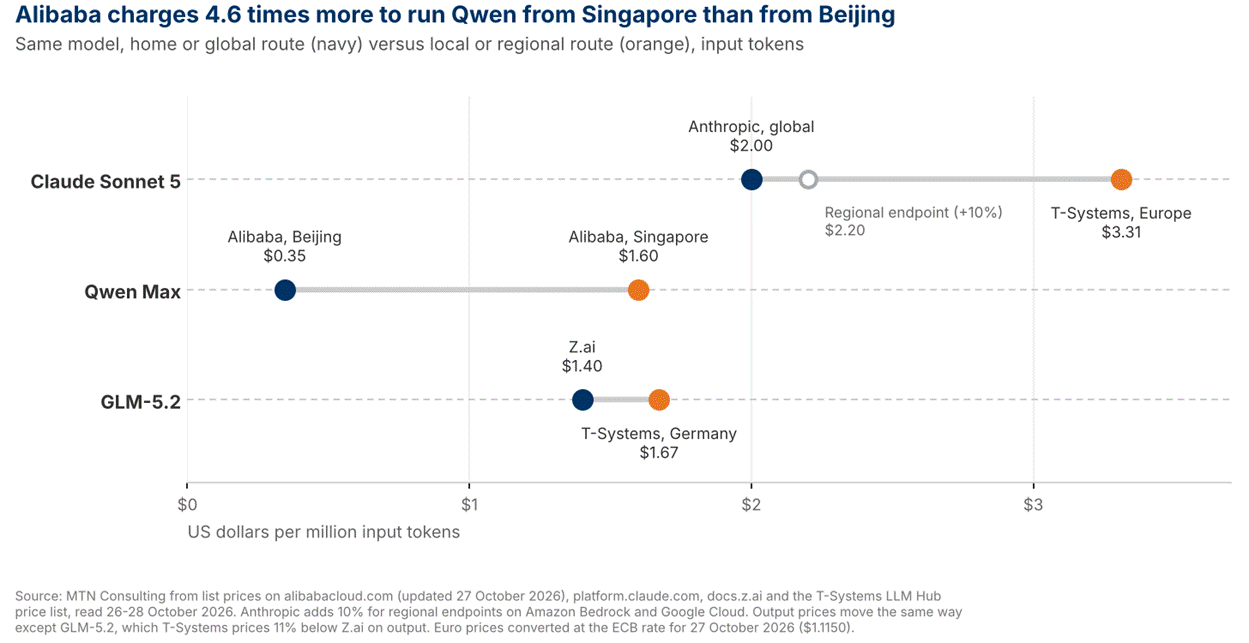
That makes the wrapper two businesses. On closed models such as Claude, the telco earns a spread on the model maker’s list price. With open models, the telco runs the model on its own GPUs, so its margin depends on how busy it keeps them. Singtel and Indosat are running both at once.
A local telco can make a Chinese model easier to buy
Singtel’s launch release gives five examples of open-weight models, and four come from Chinese developers: Qwen, GLM, Kimi and MiniMax. RE:AI runs them on its own infrastructure in Singapore. T-Systems runs Zhipu’s GLM and Alibaba’s Qwen models on its T Cloud in Germany, its price list shows.
That changes the security question for buyers wary of Chinese AI. An open-weight model running on a local telco’s servers sends prompts and data to that telco, not to the developer’s own cloud service in China. The customer gets a cheap model and a supplier it already knows and can hold to local rules. I would personally trust my local telco more than Anthropic or OpenAI.
Local hosting doesn’t settle every concern. It controls where the data goes, but not how the model was trained or what it will and won’t answer.
The wrapper has to be worth paying for
The obvious objection is that an enterprise can buy Claude or Gemini directly, so why pay a telco in the middle? Singtel, Indosat and SK Telecom aren’t building frontier models themselves, so what exactly are they offering?
What the telcos can sell is everything around the model. That means keeping data in the country, one contract across many model makers, routing that picks a cheaper model when it will do, and billing simplicity. These are all attractive features. Telcos will soon find out if they support prices high enough to deliver a reasonable margin on this new line of business.
Questions about this post? Contact the author: Matt Walker, Chief Analyst of MTN Consulting (matt@mtn-c.com)
Interested in exploring (some of) the data behind MTN Consulting’s telco AI coverage? Check out our Telco Workforce Monitor, which tracks headcount, labor costs, profitability and AI adoption at 145 telcos. We also track overseas deployments of Chinese AI models by telcos, here: https://genaitelco.com/china-ai-tracker.html.