

THE UNMANNED NETWORK – OCTOBER 2026
Bottom Line Up Front
This issue covers 15 September to 14 October 2026, a window in which telcos and their vendors reported AI results, AI-RAN trials and workforce changes.
Three items carry the most weight this issue. First, a TM Forum survey shows that telcos plan to raise autonomous network spending before most can show a financial return. Second, Deutsche Telekom (DT) set a €1.1 billion AI and automation savings target for 2027. Its finance chiefs say wage inflation and AI running costs offset that gross figure. Third, Nokia’s 2028 AI-RAN target is at least double what a study it endorsed projects.
MTN Consulting’s Gen AI Telco is tasked with tracking telecom’s AI transition, and basing analysis on credible, audited data. That is a challenge, because almost every data point released about AI comes from someone who has something to gain. Vendors release studies saying their AI solution cut costs. For this edition, we found that 42 of the 57 items logged came from a person or organization with an incentive to exaggerate. This is not unique to AI but it’s important to note. This market is young and information is very imperfect.
Telcos also struggle to show returns on autonomous networks. In a TM Forum interim survey of 78 telcos, 77% plan to raise autonomous network investment. Only 62% can link it to operational benefits and 37% can link it to financial outcomes.
Proof is also thin on the vendor side. AI-RAN builds AI into the radio access network (RAN), the base stations and antennas that connect phones to the network. The AI-RAN Alliance, an industry group launched in 2024, works in three areas. They are AI that improves the RAN, AI applications that run on it, and shared infrastructure for both.
Nokia says it has demonstrated a 20% gain in spectral efficiency, the amount of data a radio carries per unit of spectrum, and targets more than 100% by 2028. Ericsson cites up to 10% in spectral efficiency across Optus sites. Orange, which is taking Nokia’s AI-RAN into live-network testing, plans to start small.
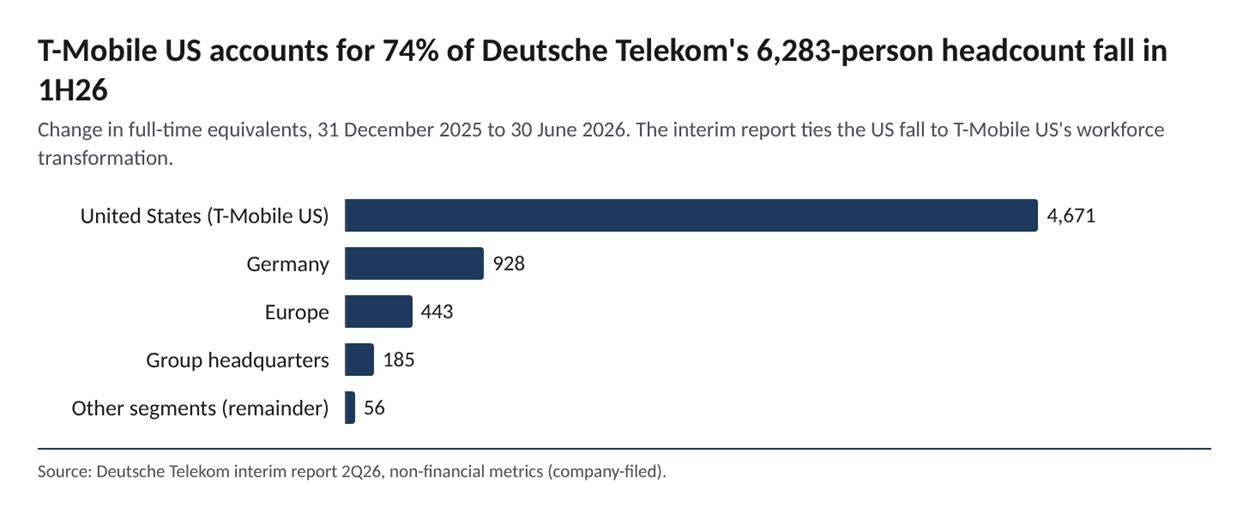
On job cuts, AI appears in savings targets but is rarely blamed. DT targets about €1.1 billion of gross savings from AI and automation outside the US in 2027. Its chief human resources officer, Birgit Bohle, said that a task-by-task review across the company already shows where DT needs fewer resources. DT gave no job count. DT’s group headcount fell 6,283 full-time equivalents (3.2%) in 1H26, and its interim report ties 4,671 of them to T-Mobile US’s workforce transformation. Telia plans about 900 position cuts, but its release never mentions AI. Telcos have little reason to blame AI for job cuts when opposition to AI is rising in some markets, so that silence settles nothing. MTN Consulting’s Telco Workforce Tracker shows that headcount at DT, Telia, Verizon, Telefónica, SK Telecom and LG Uplus fell 9% to 29% from 2Q22 to 2Q26. The role of AI in these cuts is undetermined.
Elsewhere, spending and capacity kept growing. According to the South China Morning Post, China Mobile’s Hohhot computing hub reached 20,100 petaflops, 3 times its 2024 level. SK Telecom (SKT) told employees it will build a Token Gateway business, and etnews reports an internal SKT plan for 20 gigawatts (GW) of AI data center capacity by 2035.
Signal vs. Noise
Below is a summary of recent developments in telecom AI, automation and autonomous networks, our view on why they matter, and their implications for operators, vendors and investors.
Nokia’s 2028 AI-RAN target is more than 100% spectral efficiency gain by 2028
16-Sep-26 to 12-Oct-26
Nokia says it has demonstrated a 20% spectral efficiency gain, Orange will start small in its live network and Samsung’s two Korean field projects start in October
Nokia sets the pace on AI-RAN claims, but the telcos closest to its roadmap are moving more cautiously than the vendor’s targets imply. Most of the gains below are in spectral efficiency, the amount of data a radio carries per unit of spectrum.
Ericsson’s claims rest on a rollout with few published specifics. Optus is rolling out Ericsson’s dynamic link adaptation across its Australian network, per its network chief technology officer, Sriharan Amirthalingam. Ericsson product manager Melike Erol-Kantarci put field gains at up to 10% in spectral efficiency across sites and up to 25% in certain places. Neither figure comes with a baseline or a site count. Ericsson’s March release on the Optus trial reported cell-level throughput gains of more than 20% in medium to poor radio conditions on one site, again without a baseline. Optus itself has not released results.
Nokia’s claims are larger and further out. At the Intelligent RAN Forum, Nokia said it has demonstrated a 20% spectral efficiency gain and that it targets 50% by mid-2027 and more than 100% in 2028. The report of the forum names no baseline for any of the three figures. Nokia said on 16 September that eight telcos are advancing AI-RAN proofs of concept and live trials on Nvidia platforms. They are A1 Group, Chunghwa Telecom, du, e&, Mobily, stc, TPG Telecom and Zain Saudi.
Orange, the telco closest to Nokia’s roadmap, sets a more cautious pace. Its group chief technology officer, Laurent Leboucher, says that Orange will start small in its live network and validate performance, energy use and total cost of ownership before extending. He added that Orange will not commit to one architecture and that upgrading existing AirScale equipment (from Nokia) may be the most pragmatic option in many places.
Nokia’s GPU-based RAN products already face doubt from Verizon. Nokia and Nvidia will sell graphics processing unit (GPU) based RAN products from early next year. About a year ago, Verizon chief technology officer Yago Tenorio said that telcos will not run RAN workloads on those GPUs but should use them for AI inference.
Other estimates of the gain are lower than Nokia’s target. A white paper by Chetan Sharma Consulting that Nokia endorsed projects 40% to 50% under favorable conditions. Nokia’s 2028 target is at least double the top of that range. Marcus Weldon, a former Nokia chief technology officer, puts the realistic gain at 20% to 30%, closer to Ericsson’s published figures. He calls a doubling possible only in niche scenarios.
Korea may supply the next field evidence. Samsung says it is the sole global vendor for KT and the main vendor for SKT in two government-funded Hyper AI Network projects. The projects, starting in October 2026, cover field trials at the HD Hyundai Samho shipyard and validation at SK Incheon Petrochem.
Why it matters: Buyers should treat every AI-RAN gain claim as an upwards bound target, unless the result is published and has a clear baseline. Ideally the result would also be audited by an independent third party, but that almost never happens. Ericsson sells its package as software for the installed base, with no new hardware, so its claims are cheap to test. Nokia’s larger gains depend on new hardware, and the GPU decision turns on whether a telco sees the GPU as RAN capacity or as an inference server. Verizon’s chief technology officer has already said the second. Orange’s live-network validation, the two Korean projects and the first telco comment on Nokia and Nvidia’s products will show which view holds.
Source: https://www.ericsson.com/en/press-releases/7/2026/optus-and-ericsson-trial-ai-to-boost-5g-downlink
Source: https://www.lightreading.com/5g/nokia-to-start-dealing-out-gpus-in-high-stakes-ai-ran-gamble
Deutsche Telekom targets €1.1 billion of gross AI savings; its HR chief says it already sees where it needs fewer resources
05-Oct-26
Group headcount fell 6,283 full-time equivalents (3.2%) in 1H26, and the interim report ties 74% of the fall to T-Mobile US’s workforce transformation
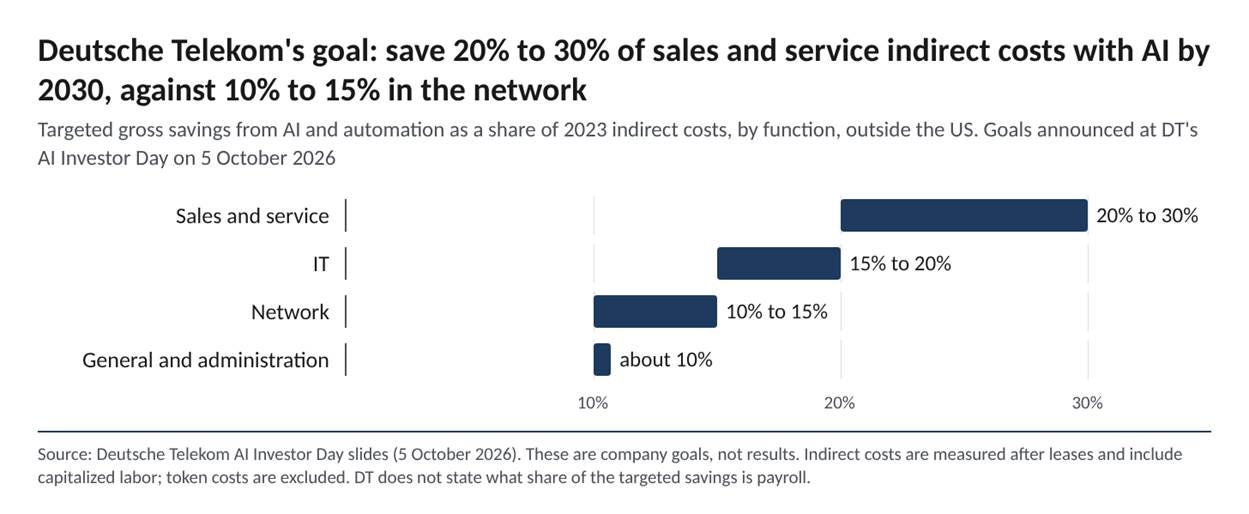
DT announced goals for AI revenue and savings at its AI Investor Day in Bonn on 5 October 2026. The company’s press release reports about €250 million of AI-related revenue outside the US in 2026 and targets about €800 million by 2030. DT’s presentation raises its 2027 estimate of gross savings from AI and automation to about €1.1 billion, from about €0.8 billion at its 2024 capital markets day. About €1.0 billion is indirect costs and about €0.1 billion is capital expenditure. It puts targeted gross savings at about 4% of indirect costs in 2026, 6% in 2027 and 15% in 2030, or about €2.5 billion. All figures compare with a 2023 baseline, exclude the US and token costs, and measure indirect costs after leases but including capitalized labor.
The savings do not lift DT’s profit guidance. DT confirmed two 2027 targets. Adjusted earnings before interest, taxes, depreciation and amortization (EBITDA) after leases is about €16 billion, and free cash flow after leases is €3.7 billion to €3.9 billion. DT says AI-related operating savings are reinvested in accelerated digital transformation. It does not say what share it reinvests.
DT’s finance chiefs explained the flat guidance on stage, in the event transcript. Christian Illek, the current chief financial officer, said DT is investing heavily but has not yet scaled most projects. He admitted that some projects failed and ended up costing more than they saved. Each business segment pays for its own token use, and he expects token costs to stay below a low double-digit percentage of gross savings. Dhananjay Mirchandani, who becomes chief financial officer in May 2027, said it is too early to attribute margin gains to the savings. He cited wage inflation and the running cost of AI systems as offsets. The €1.1 billion is therefore a gross figure, and DT has not netted it against those costs.
Sales and service carries the largest 2030 savings target of any function on DT’s slides. DT also aims for AI to handle every initial call and for calls and chats to fall 50% to 55% from 2023. The release says its Frag Magenta chatbot handled about 2.6 million calls in 1H26, US customer service calls fell 55%, and AI agents handle 40% of US customer contacts. A T-Mobile US executive told the event that calls handled by humans in customer care were down 55% in 2Q26. The target is 75% by the end of 2027. T-Mobile US’s slide shows annual contacts per account falling from 7.0 in 4Q21 to 3.1 in 2Q26, a 56% fall, which may be the same measure. That slide puts the share of postpaid contacts served by an AI agent at 32%, against 40% in the release, but the two may not measure the same thing.
The workforce slides give no numbers. DT’s workforce redesign slide shows the current workforce mix evolving in three possible ways: reskill, build up, or reduce. It lists an assessment of AI potential by role, task and activity as the method, and the operating-model slide says impact and workforce effects stay transparent. The presentation contains no headcount target, but it does share an example. For a midmarket logistics firm with 100 employees, DT says its agent platform releases 15 to 20 full-time equivalents worth €0.9 million to €1.2 million a year. It gives no such estimate for DT’s own workforce.
The executives said more about jobs on stage than the slides do. Birgit Bohle, DT’s chief human resources officer, said no one knows what AI will mean for the workforce over ten years. She also said DT’s task-level review of roles already shows where it needs fewer resources, and that DT will accelerate its workforce transformation in a socially responsible way. Chief executive Tim Höttges described an expense claim that passes through 10 to 12 departments and said an agent can cut people out of that chain. Group technology officer Arash Ashouriha said the 30% network productivity target could mean handling more work or moving network experts to other tasks.
DT’s own interim report breaks down where headcount went. Group full-time equivalents fell from 198,079 at the end of 2025 to 191,796 on 30 June 2026, a drop of 6,283, or 3.2%. T-Mobile US accounts for 4,671 of that, or 74%, which the report attributes to its 2025-2026 workforce transformation. Germany fell 928, helped by phased retirement, and Europe fell 443, mainly in Greece and Poland. The report names no AI cause for any of these declines. T-Mobile US also ties its cuts to retail store closures and the UScellular acquisition. The MTN Consulting Telco Workforce Tracker puts DT’s headcount at 210,595 at 2Q22 and 191,796 at 2Q26, down 8.9%. The fall came late: headcount was flat in 2025 but fell 3.2% in 1H26.
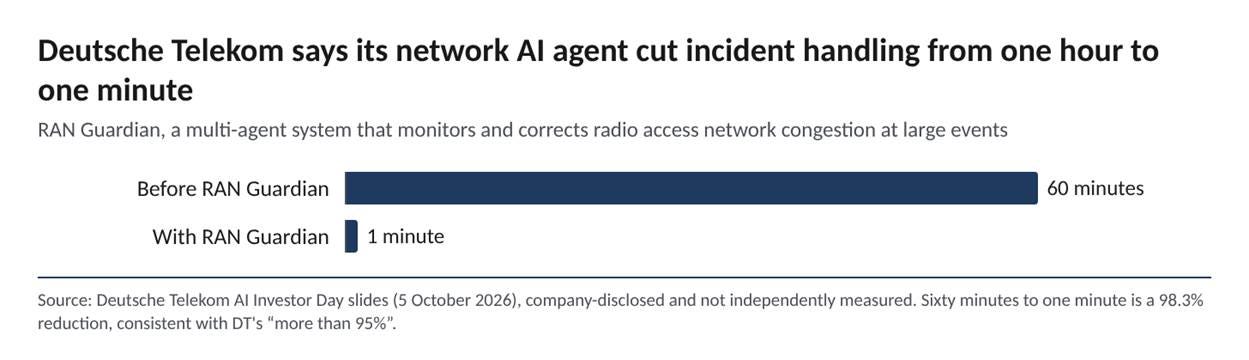
AI evidence from the network is more focused than for customer-service. DT’s presentation says its RAN Guardian agent made incident handling more than 95% faster, from one hour to one minute. The agent monitors and corrects congestion in the radio access network at large events, and DT says it widened event coverage from 1,000 to 100,000 events. DT’s slide gives one hour as the old handling time, so one minute is a 98.3% reduction, consistent with the “more than 95%” claim. MINDR is DT’s multi-agent system for faults across radio, transport and core, but it is not yet in production. So, its slide lists targets, not results: more than 90% of tickets handled automatically and network restored within 60 minutes of any incident. Ashouriha called MINDR a “minimum viable product” that DT is still hardening. DT puts network gross savings at 10% to 15% by 2030. In 2025, outside the US, DT’s network operating cost was €4.3 billion and its capital expenditure was €5.8 billion.
Light Reading estimates, by a calculation it calls crude, that up to 25,000 roles could be at risk. The estimate assumes all savings come from headcount cuts spread evenly across salary bands, against about €19.8 billion of personnel costs last year. DT’s slides do not show how much of the savings is payroll.
The 1H26 decline shows no AI effect. Most of it sits in a US unit that cites restructuring and store closures, and the German decline came through phased retirement. T-Mobile US also moved software engineering from an outsourced workforce to its own staff, which raises an employee count. DT’s targets point to a different outcome from 2027. DT attributes its savings to AI and automation and expects bots to take first contact in customer service. Its human resources chief says DT already sees where it needs fewer resources. A headcount effect is plausible from 2027 and unproven today.
Why it matters: Investors can hold DT to the €1.1 billion for 2027, but they cannot use the 1H26 headcount decline as evidence for it. DT’s finance chiefs say wage inflation, AI running costs and the cost of failed projects offset the gross savings, so the figure is not a margin forecast. Network vendors such as Ericsson and Nokia face a buyer that builds its own agents. DT’s group technology officer, Arash Ashouriha, said that DT’s agents never act on a network element directly. They act through a Model Context Protocol (MCP) gateway that limits what each agent may do. DT developed RAN Guardian and MINDR in-house. Its chief network officer for Europe, Armin Sumesgutner, said DT starts from what the industry offers and builds on top of it. Vendors that publish interfaces through which an agent can query network state and perform permitted actions supply what DT’s gateway design needs. Vendors that sell closed agents of their own compete with the systems DT has already built.
Source: https://www.telekom.com/en/investor-relations/publications/capital-markets-days/ai-investor-day
Globe credits AI with PHP1.2 billion of value, 68% of it incremental revenue
25-Sep-26
A 2.8x return on AI investment implies about PHP430 million of spend if it divides value by investment
Globe Telecom split its AI value into revenue, cost and time. In a recent release, Globe reports that its AI programs produced PHP1.2 billion of measurable value as of August 2026. This is comprised of over PHP825 million of incremental revenue, PHP368 million of cost avoidance and PHP28 million of productivity value, which the release equates to over 52,000 labor hours saved. Globe also reports a 2.8x return on AI investment and 90% enterprise AI adoption, and says its community of AI builders has grown to over 450 employees.
Globe’s claims require a caveat. Incremental revenue needs a counterfactual, meaning an estimate of what revenue would have been without AI, and the press release gives none. Cost avoidance counts spending that did not happen, so it cannot be found in the income statement. The release does, however, list the areas addressed by AI at Globe: finance, customer engagement, marketing technology and order management. The productivity line values 52,000 hours at PHP28 million, or about PHP538 an hour. At 2,080 working hours a year, those hours equal about 25 full-time employees for one year. Globe does not say whether the hours reduced anyone’s workload or headcount.
The 2.8x return has no stated formula. If it divides value by investment, Globe’s AI investment would be about PHP430 million (PHP1,200 million divided by 2.8). The release does not give the investment, so the figure is implied, not reported. Globe’s chief executive, Carl Cruz, says the real measure of AI is what it improves, not how many people use it.
Why it matters: Globe is the only telco in this issue that splits realized AI value into revenue, cost and time. Other telcos may be asked to match that template. Investors and AI vendors should ask for assumptions behind the revenue counterfactual and the investment base behind the 2.8x. They should also ask whether the avoided costs repeat every year or occur once.
Source: https://www.globe.com.ph/about-us/newsroom/corporate/globe-ai-adoption-impact-1-2b-value
Telstra’s AI token use grew 275%; 80% goes to customer service and code
22-Sep-26 to 06-Oct-26
Its technology chief rates Telstra’s network below Level 2 on TM Forum’s autonomy scale of 0 to 5 and tells telcos to fix basics first
Telstra shows where a telco’s AI actually runs. At FutureNet Asia, Group Executive Kim Krogh Andersen said Telstra’s token consumption grew 275% last year. It now averages 15 billion tokens a day across more than 400 use cases. He said costs fell 7%. He gave the token usage split: customer experience 56%, software engineering 24%, autonomous networks 12% and cybersecurity 8%. Customer experience and software engineering together take 80%.
Andersen did not say whether the 7% is total cost or cost per token. Most likely it is total cost. That would imply that token volume rose 3.75 times while spend fell 7%, which implies a cost per token about 75% lower.
On network autonomy, Andersen said a recent internal assessment places Telstra below Level 2 on TM Forum’s autonomous networks scale, which runs from Level 0 to Level 5. He said the industry will not reach Level 4 without retiring legacy systems.
Telstra’s production agents also work in the contact center. Salesforce says two Agentforce agents are in production at Telstra and together support more than 1,000 contact center representatives. One guides refunds during fixed-service outages and one audits access permissions. Salesforce expects such agents to resolve hundreds of thousands of routine inquiries a year.
Telstra’s headcount has fallen since 2023. In the MTN Consulting Telco Workforce Tracker (2Q26 edition), Telstra’s year-end headcount peaked at 32,579 in 2023. It stood at 29,334 at 2Q26, a fall of 10.0%. The longer comparison looks different. From 2Q22 to 2Q26, Telstra’s headcount rose 1.5%, from 28,889 to 29,334, while the median across 72 telcos fell 6.9%. That base sits just after a 4,906 jump in Telstra’s 2022 year-end count. Telstra added about 1,700 Digicel Pacific staff on 14 July 2022, which accounts for part of that jump, and the tracker does not adjust for acquisitions or divestitures.
Revenue per employee fell 1.5% a year at Telstra against a median rise of 4.4%. Telstra’s earnings before interest and taxes (EBIT) margin rose 10.2 percentage points against a median rise of 0.1. MTN Consulting’s profile records a statement by chief executive Vicki Brady at the 27 May 2025 investor day. She said she believes Telstra’s workforce will likely be smaller in 2030 than today.
Why it matters: Telstra’s token mix shows that its AI use concentrates in customer experience and code, which take 80%, while autonomous networks take 12%. Telstra’s technology chief names retiring legacy systems as the precondition for network autonomy, so vendors selling autonomy tools should expect that work to come first. Vendors should concentrate marketing energy on helping telcos retire this legacy infrastructure, not just encourage them to deploy the next-generation.
Source: https://www.telstra.com.au/exchange/expanding-the-telstra-family-with-digicel-pacific
China Mobile’s Hohhot hub tripled to 20,100 petaflops as China Telecom’s token platform passed 170 models
23-Sep-26 to 13-Oct-26
Both numbers measure supply: a petaflop figure is capacity and a model count is catalog size
China’s state telcos have been talking about network capacity recently. For example, China Telecom general manager Liu Guiqing spoke at the 2026 China International Information and Communications Technology Exhibition on 23 September. He said the company manages more than 118 exaflops of computing power across 16 data center parks of the 100-megawatt class. He said its Xingchen Token Hub now supports more than 170 large models. He added that China Telecom will form an AI Token global service ecosystem alliance. Our previous issue reported 142 models on the platform from China Telecom’s interim results, so the count rose by at least 28, or about 20%, since August.
China Mobile’s capacity news concerns a single hub. Citing Inner Mongolia Daily, the South China Morning Post reports that the Hohhot hub reached 20,100 petaflops after an expansion. Of those, 16,700 petaflops serve AI and smart computing. A 2024 state press report put the hub at 6,700 petaflops, so capacity tripled. The newspaper does not say whether the two figures use the same numerical precision, so the tripling may not be like for like.
Table B below shows the procurement behind this capacity. It includes a China Mobile tender for 20,480 AI cards and C114’s count of 36.6 billion yuan of telco data center tenders in 3Q26.
Why it matters: A model count measures catalog size, not usage, and a petaflop figure measures capacity, not demand. Token volumes and revenue per token would show whether selling tokens by subscription works. A token revenue line in any Chinese state telco’s 3Q26 results would answer that.
Source: https://www.c114.com.cn/news/117/a1318271.html
SK Telecom runs 14 million AI requests a day on Rebellions chips and plans a Token Gateway business
21-Sep-26 to 12-Oct-26
etnews reports an internal SKT blueprint for 20 GW of AI data center capacity by 2035, citing industry sources
Rebellions, the Korean AI chip maker, reports that its ATOM-Max servers handle about 14 million real-time requests a day across four SKT services. They process more than 4 billion tokens a day. The servers are built on neural processing units (NPUs). The first of the four, a call summary feature in the A. dot app, entered commercial use in December 2025. A streaming text-to-speech service, an AI call center post-consultation and search system, and a scam bait-text detector followed from June 2026. The figures come from Rebellions, which merged with SAPEON Korea, a unit linked to SKT, in December 2024.
SKT’s chief executive, Jung Jae-heon, presented a Growth Gear strategy at an employee town hall on 8 October. It links telecom, AI services and AI infrastructure around a goal of leading the token economy. SKT’s Token Gateway business will route enterprises and customers to the best-suited model or infrastructure. It builds on SKT’s roughly 23 million customers, its payment system and its AI platform. Jung said AI transformation has already improved efficiency by automating repetitive work, and that the next step is to redesign work methods and organization around it. SKT will run an internal open call soon to move employees into core growth businesses. SKT’s release targets commercial service of its AI factory with Nvidia for next year.
etnews adds a larger number for the infrastructure side. Citing telecom industry sources, it reports that Jeong Seok-geun, head of SKT’s AI unit, shared an internal blueprint for 20 GW of AI data center capacity by 2035. The plan combines the 15 GW SKT has already announced for Korea and 5 GW overseas, likely with local partners. etnews says SK Group chairman Chey Tae-won named Japan as the first overseas target in a Nikkei interview.
The open call is SKT’s workforce news this month. SKT frames redesigning work around AI and moving staff into growth businesses as redeployment, and it gives no position numbers.
Why it matters: SKT is moving toward selling tokens and compute, but its public evidence so far is request volume from a chip supplier, not revenue. The Token Gateway puts SKT beside the Chinese token platforms above and the Singtel and Indosat services in Table C: a metered AI product with a per-unit price. For chip vendors, Rebellions shows that a Korean NPU can carry production telco traffic. For investors, the first disclosed Token Gateway revenue is the test.
Source: https://kr.rebellions.ai/newsroom/rebellions_running_14000traffic_skt_commercialization/
Source: https://news.sktelecom.com/231883
Source: https://www.etnews.com/20261012000272
77% of surveyed telcos plan to raise autonomous network spending, but only 37% can show the financial return
07-Oct-26 to 08-Oct-26
TM Forum says 72% of telcos believe their AI is trustworthy but only 14% can verify it
TM Forum’s interim survey shows how few telcos can link autonomous network spending to results. The survey of 78 telcos finds that 77% plan to raise autonomous network investment, 62% can link it to operational benefits but only 37% can link it to financial outcomes. A further 51% say vendors provide too little tooling to measure return. Final results are due in December 2026.
A second TM Forum finding concerns trust. In its announcement of a Trustworthy AI program with Accenture, TM Forum says that 72% of telcos believe their AI is trustworthy but only 14% can verify it. The figures come from “recent TM Forum research” that the release does not describe or link. The two organizations will build an AI trust certification over several years, with no launch date.
Broadband providers also cite data and AI integration as obstacles. In a Broadband Forum survey of 100 broadband network decision makers, 94% plan to use software-defined networking and 92% call AI and machine learning integration critical or important. In the same survey, 83% cite poor, inconsistent data as a major barrier. STL Partners produced the report, and Radisys and Incognito Software Systems sponsored it. Both sponsors sell software to broadband providers.
Why it matters: Vendors selling autonomous network tools face buyers with budget intent but no internal proof of return. That gap lengthens sales cycles and favors vendors that ship measurement with the product. The 51% who say vendors provide too little tooling to measure return point to demand for built-in measurement. A telco that publishes a result with a baseline and a financial outcome stands apart from the 63% who cannot.
LG Uplus cut average contact center waits from 47 seconds to 5
15-Sep-26 to 08-Oct-26
Another eight telcos report volumes and speed gains
A growing list of telcos is opening up about their AI deployments, sharing data on volumes and speeds. LG Uplus is unique among recent reporters, as it reports clear before and after results, but it measures wait time, not cost. Verizon’s “thousands” of saved technician hours and T-Mobile’s “about half the time” give no base against which to test them.
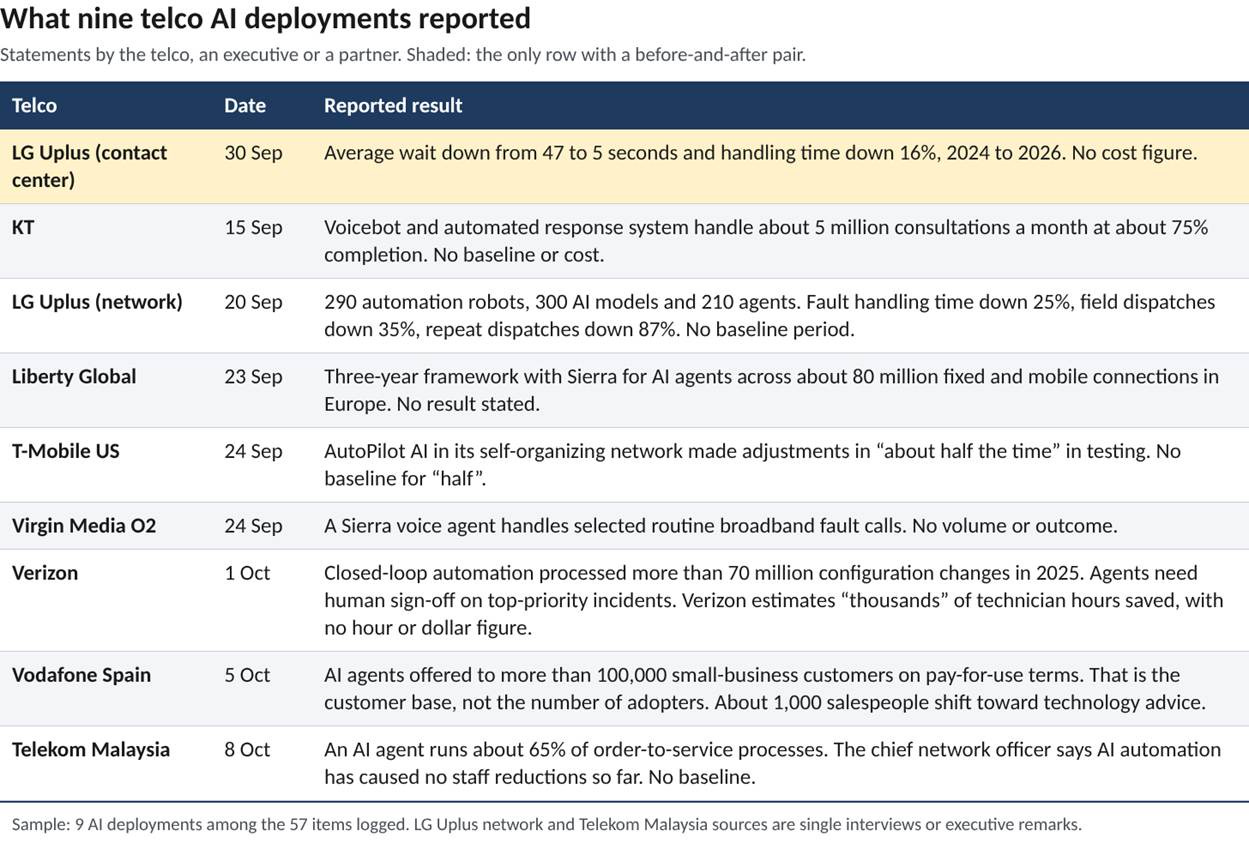
Why it matters: Buyers can compare these deployments on scale and speed, although not on financial return. A telco that publishes a saving with a baseline would give buyers a comparison point.
Source: https://news.lguplus.com/22900
Source: https://www.t-mobile.com/news/network/t-mobile-ai-and-resilience-make-5g-network-stronger
Source: https://rcrwireless.com/20261001/ai-infrastructure/agentic-verizon-draws-line-marks-difference
Chinese telcos tendered 36.6 billion yuan of data center infrastructure in 3Q26; Deutsche Telekom’s incoming chief financial officer indicates no extra radio spending for AI
30-Sep-26 to 13-Oct-26
DT guides 2027 capex at 21% of service revenue excluding the US
Spending news related to telco use of AI helps understand priorities. Deutsche Telekom’s incoming chief financial officer could recall no discussion of extra radio spending for AI, so on his account AI-RAN has not changed DT’s plan. By contrast, Chinese telcos are carving out big additional chunks of budget for AI factories. For instance, China Mobile recently floated a tender for over 20K AI cards (GPUs). That’s separate from the big recent tender for civil works related to the AI buildout in China: per C114, the 36.588 billion yuan total spend counts only power, cooling, civil works and cabling.
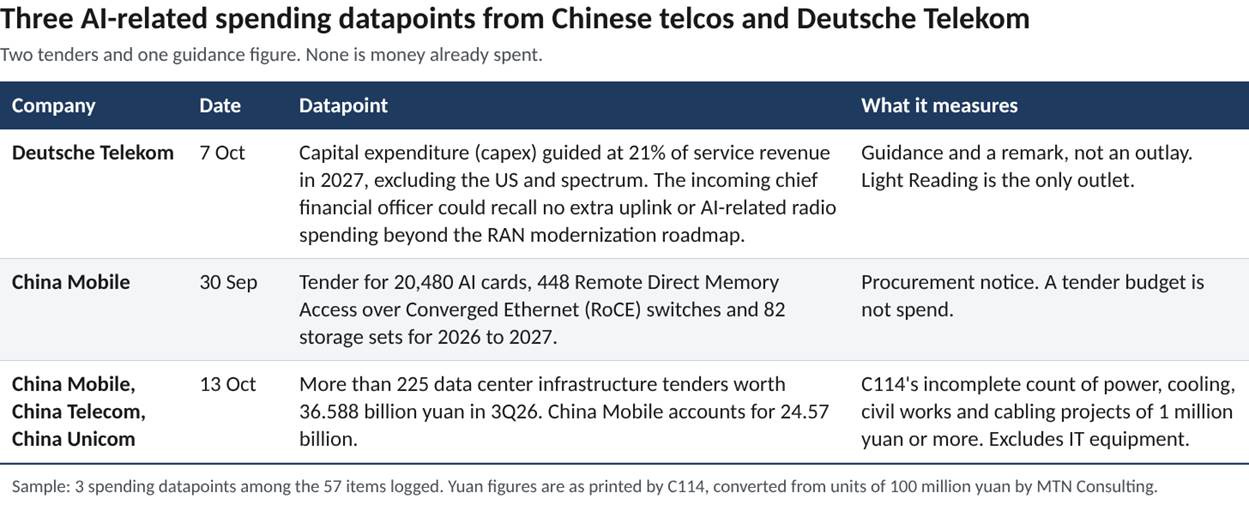
Why it matters: The two buyers in this story draw on different vendors, so the signals matter to different readers. For Chinese AI chip and server makers, China Mobile’s September notice seeks 20,480 AI cards, 3.3 times the 6,208 cards it tendered in March. The March tender specified Huawei’s Compute Architecture for Neural Networks (CANN), the software platform for its Ascend AI chips. C114 says that order shows domestic computing power can handle national-scale AI tasks. The September notice names no chip, so it does not show whether domestic suppliers win the larger order. Chinese telcos do have a reason to favor them, because export controls limit access to advanced foreign AI chips. For vendors selling radio equipment to Western telcos, DT’s incoming chief financial officer recalls no extra radio spending for AI. On this evidence, vendors should not expect AI to lift DT’s radio orders.
Source: https://www.c114.com.cn/news/118/a1318698.html
Source: https://www.c114.com.cn/news/16/a1319018.html
Source: https://m.c114.com.cn/w118-1307117.html
Smart priced its AI service from PHP49 for 7 days, the one published price among eight telco AI launches
22-Sep-26 to 09-Oct-26
Recent launches take three forms: metered tokens, cloud capacity and partnerships
Telcos announced three kinds of AI service this month: metered tokens (Singtel, Indosat, Smart), capacity and cloud (Uztelecom, Claro), and partnerships (Bell twice, VEON). Smart is the only one to publish prices, but as a prepaid consumer product it says little about enterprise demand. Indosat names a target of 50 businesses at launch, but that’s just a goal. VEON’s 27% share covers digital and AI services together, so it cannot size AI revenue.
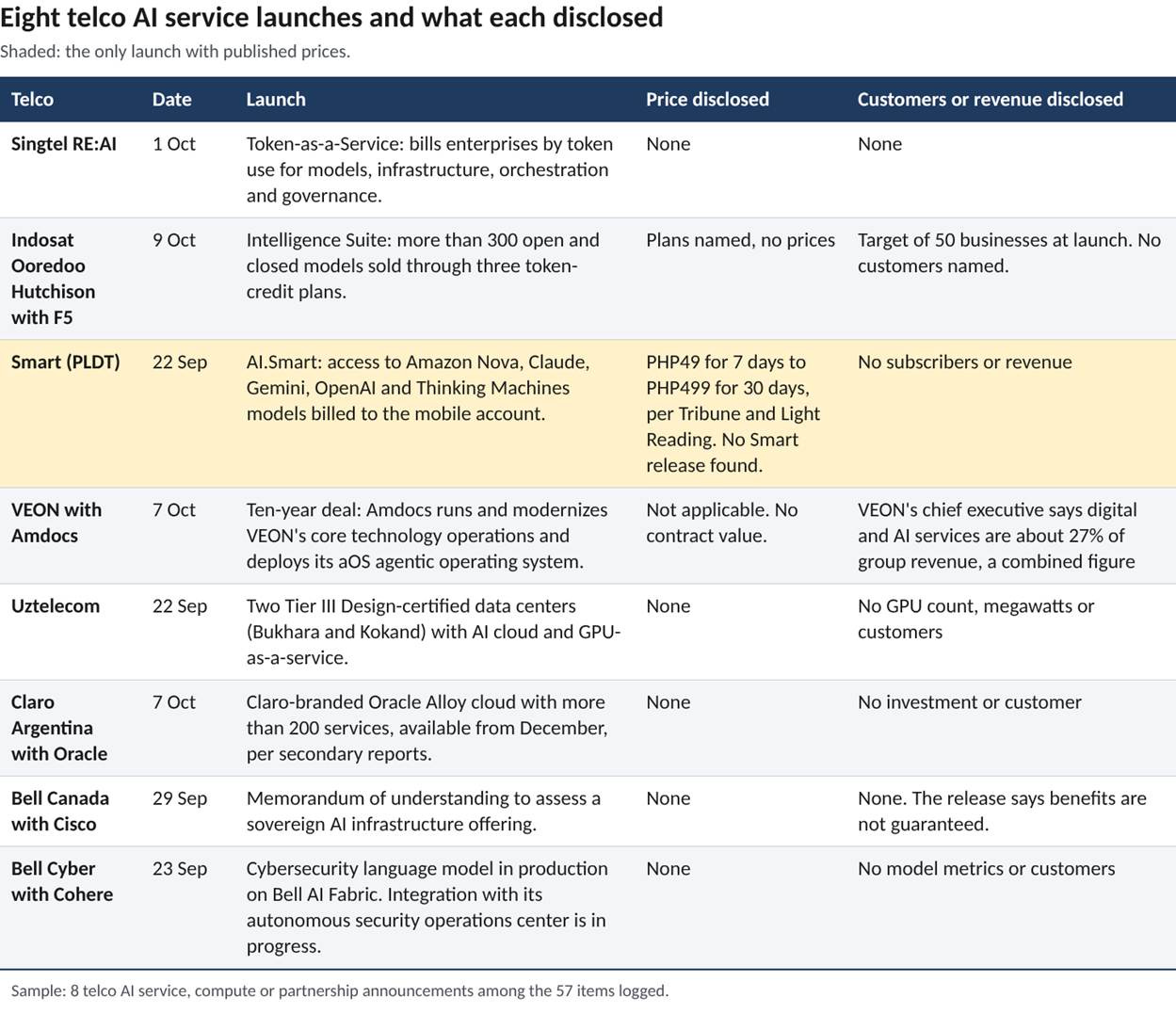
Why it matters: Telcos have launched token and GPU services, but none has shown that anyone is buying them. Seven of the eight launches publish no price, and none discloses a customer count or an AI revenue figure. Indosat’s target of 50 businesses is the only customer figure, and it is a goal. Smart’s price list, from PHP49 for 7 days to PHP499 for 30 days, covers a consumer prepaid product and tells enterprise vendors little about business pricing. Vendors selling metering, billing or GPU capacity to these telcos should ask for the demand case behind each launch before they commit capacity. Investors should treat the first disclosed token revenue line, even a small one, as the first evidence that the category sells.
Source: https://tribune.net.ph/2026/09/22/smart-targets-prepaid-market-with-low-cost-ai
72% of surveyed operators plan to use digital twins but only 13% do today; 8% of UK online adults use AI “in relation to” their telecoms services
23-Sep-26 to 13-Oct-26
Other recent news items center around plans, claims or a committee launch, and BT’s £3.67 billion estimate comes from the seller of the product it supports
Standards bodies and surveys supplied the month’s autonomy benchmarks, but most of them describe plans. TM Forum’s survey of 128 operators shows the gap: 72% plan to use digital twins to enable autonomous networks and agentic AI, but only 13% already do. Ofcom’s survey is the exception: it asks consumers what they used. It finds that 8% of online adults use an AI tool in relation to their telecoms services. The uses are resolving an issue (6%), comparing prices, products or services (3%) and making a complaint (2%). Those uses overlap, since the shares sum to 11%. AT&T’s Level 4 RAN claim has no outside assessment behind it, and TM Forum’s 20 solution packages name no adopter. BT claims its new AI Receptionist tool helps customers recover missed revenues, but this is based purely on a BT-sponsored model.
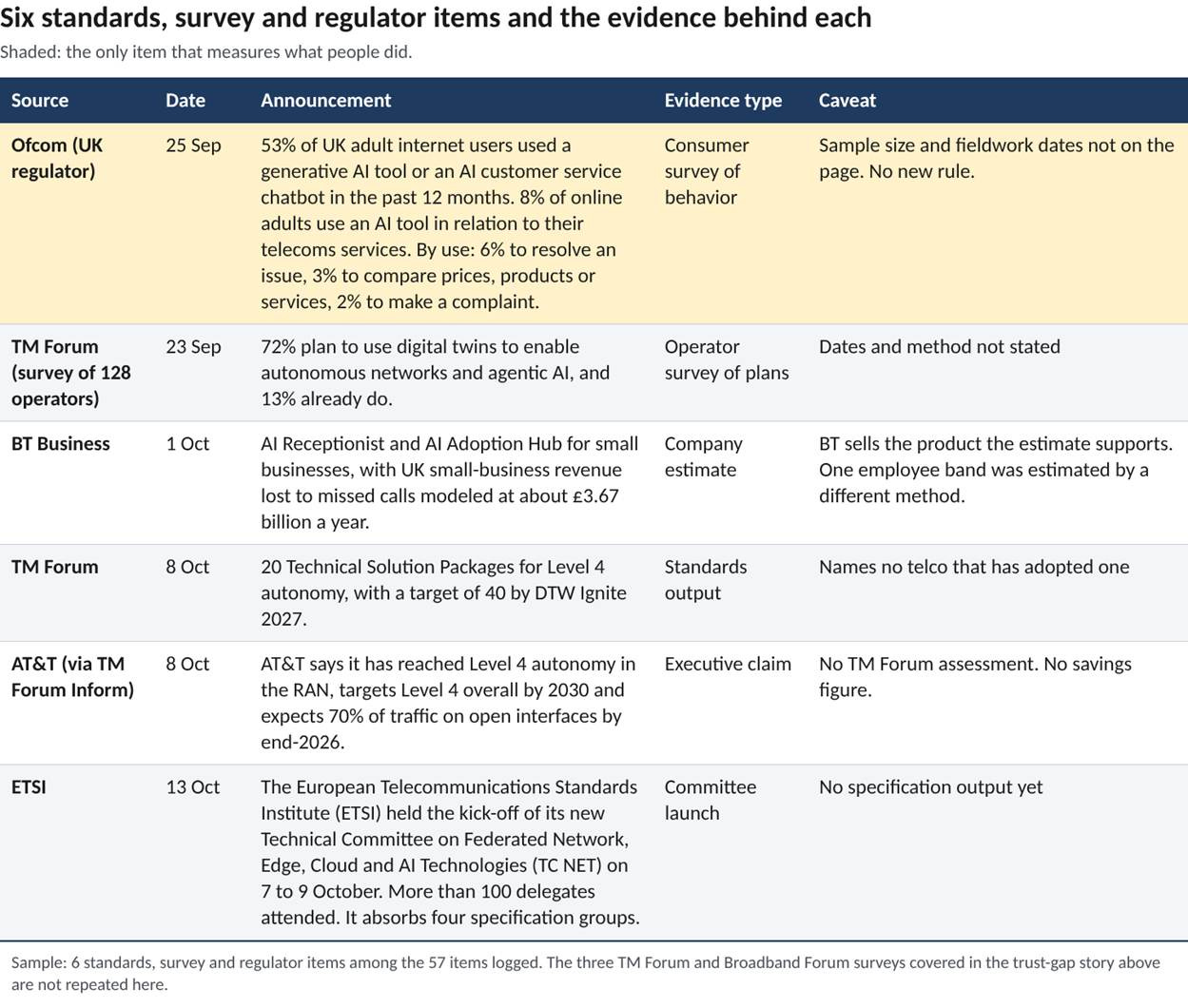
Why it matters: Operator plans run well ahead of use. A digital twin is a virtual model of a network used to test changes before they go live, and the survey finds far more operators planning one than running one. Consumer use is narrower, and its largest category is resolving an issue. That is a customer-care task, not network autonomy. Vendors selling autonomy tools are selling into plans, so they should expect buyers to ask for a named adopter with a measured result. Telcos choosing where to start with customer-facing AI have one measured use to build on: resolving customer issues.
ZTE and XLSmart’s agent reached a 25% closed-loop completion rate in a live network test
10-Sep-26 to 08-Oct-26
Ericsson quotes 4x capacity against its own earlier processor, a vendor comparison
The most useful evidence on the vaue of telco AI would come from a telco directly, and be based upon a live network test. Of the 7 items in this story, only one fits this bill. XLSmart and ZTE tested a network optimization agent on live coverage-optimization scenarios; the closed-loop completion rate was 25% within the tested scope. The article, by Selular.ID, says the agent analyzes network conditions, drafts an optimization strategy and executes the needed actions. The article gives no scenario count. The article presents the test as one stage toward Autonomous Network Level 4 and says the results show which parts still need human intervention: about 75% of cases.
Ericsson also announced deployment of a new RAN processor at Vodafone Egypt. Ericsson says its 4x capacity and 50% energy figures compare its new processor with its own earlier generation. The other five of the seven items quote no performance figure.
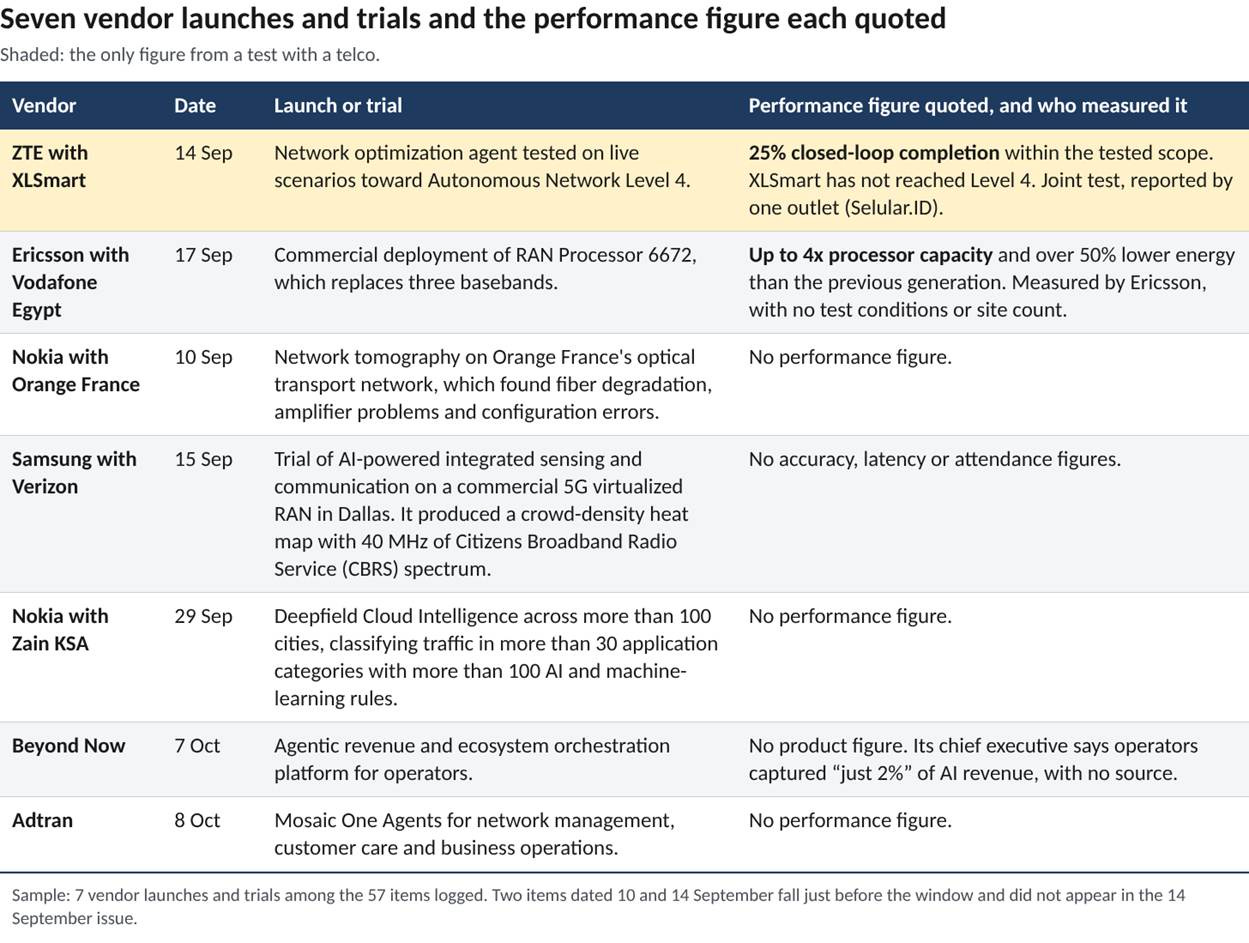
Why it matters: A 25% closed-loop completion rate is low for a test that the article presents as one stage toward Level 4, where a network increasingly runs itself. It is the only figure in this group from a live test with a telco. Telcos evaluating autonomy agents should ask each vendor for the completion rate in a live network test, the number of scenarios tested and how the unfinished cases were handled. The answers separate a tested product from a launch announcement.
Source: https://www.ericsson.com/en/press-releases/1/2026/vodafone-egypt-brings-ai-with-ericsson-processor
Source: https://selular.id/2026/09/xlsmart-dan-zte-uji-ai-agent-untuk-autonomous-network-level-4/
Headcount fell 9% to 29% at six telcos from 2Q22 to 2Q26; Telia cites localization, not AI, for its latest 900 cuts
23-Sep-26 to 12-Oct-26
Telia, Verizon and Telefónica fell 18% to 29%, but their stated reasons name restructuring and localization, not AI
A telco’s stated reason for a job cut is something you should take with a grain of salt. MTN Consulting tests each stated reason four ways. The tests ask whether the reason names a function that AI automates, and whether the company claims AI savings in that function. They also ask whether a non-AI explanation exists, and whether the company made similar cuts before without citing AI.
Telia illustrates why the tests matter. Its 900 announced cuts are the only new job-cut number among the nine telcos in the table below. Telia has now announced about 4,500 across three rounds since December 2024, but none of the three cites AI. Deutsche Telekom shows the opposite risk. It cites AI for 2027 savings but attributes its 1H26 headcount decline to other causes. The future effect is plausible but the past effect is not shown.
Per the MTN Consulting Telco Workforce Tracker, from 2Q22 to 2Q26, headcount fell at all six telcos in the table below, by 9% to 29%. Telia, Verizon and Telefónica fell 18% to 29%, but none of the three attributes the fall to AI. Verizon’s figure includes Frontier Communications staff added in 2026, so its fall excluding Frontier is larger. The tracker does not adjust for acquisitions or divestitures. Telefónica has agreed to sell its Argentine, Colombian and Peruvian businesses, so portfolio change explains part of its fall.
The tracker’s wider findings argue against attributing these falls to AI. In its 2Q26 findings, MTN Consulting reports that headcount across its 145-telco panel fell 2.1% year on year to 4,285,701. The decline began several years before the AI cycle. Across 72 telcos, a telco’s headcount change had no measurable relationship to its change in earnings before interest and taxes margin. A fall in headcount at one telco therefore needs company-level evidence before anyone credits AI for it.
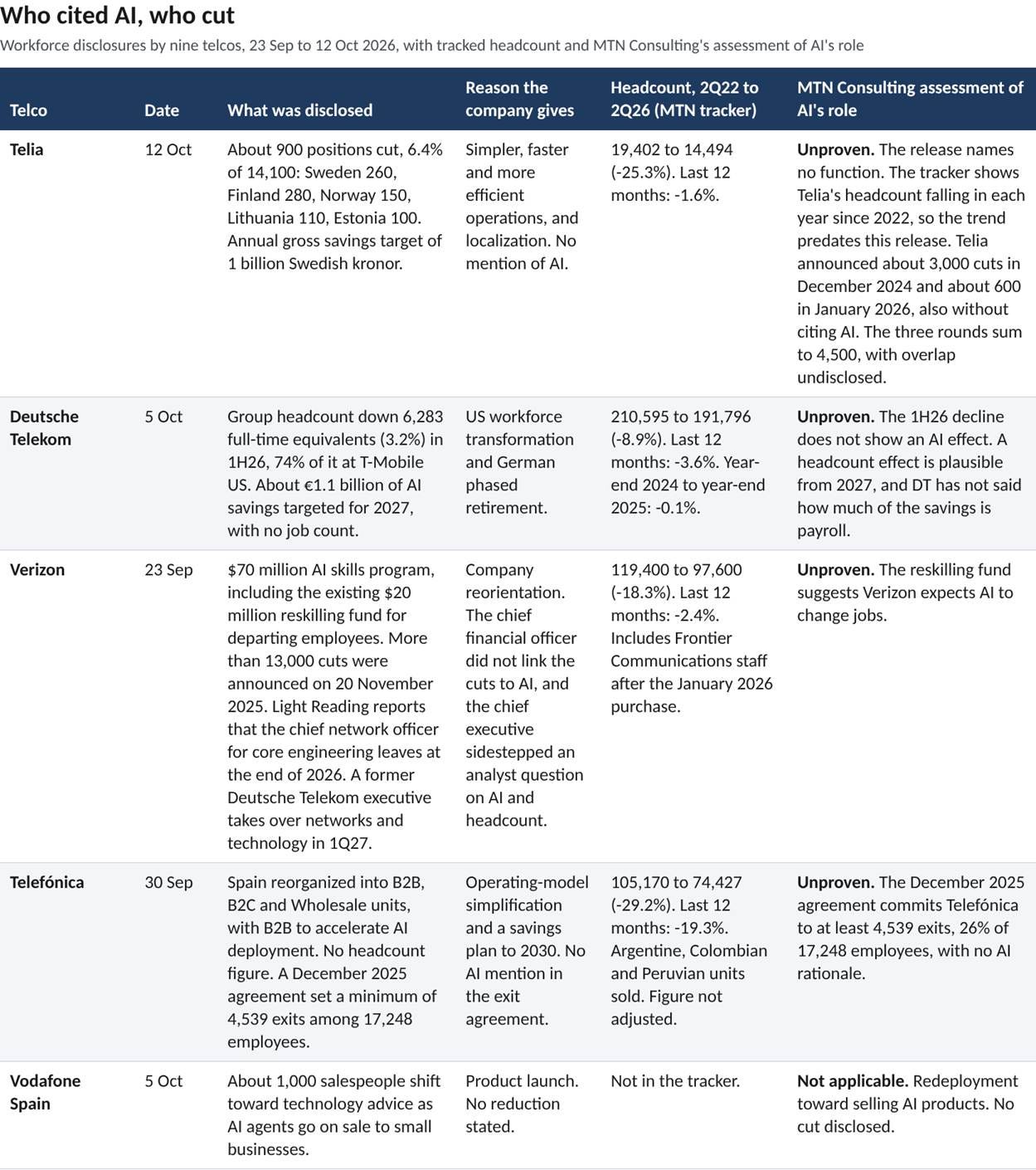
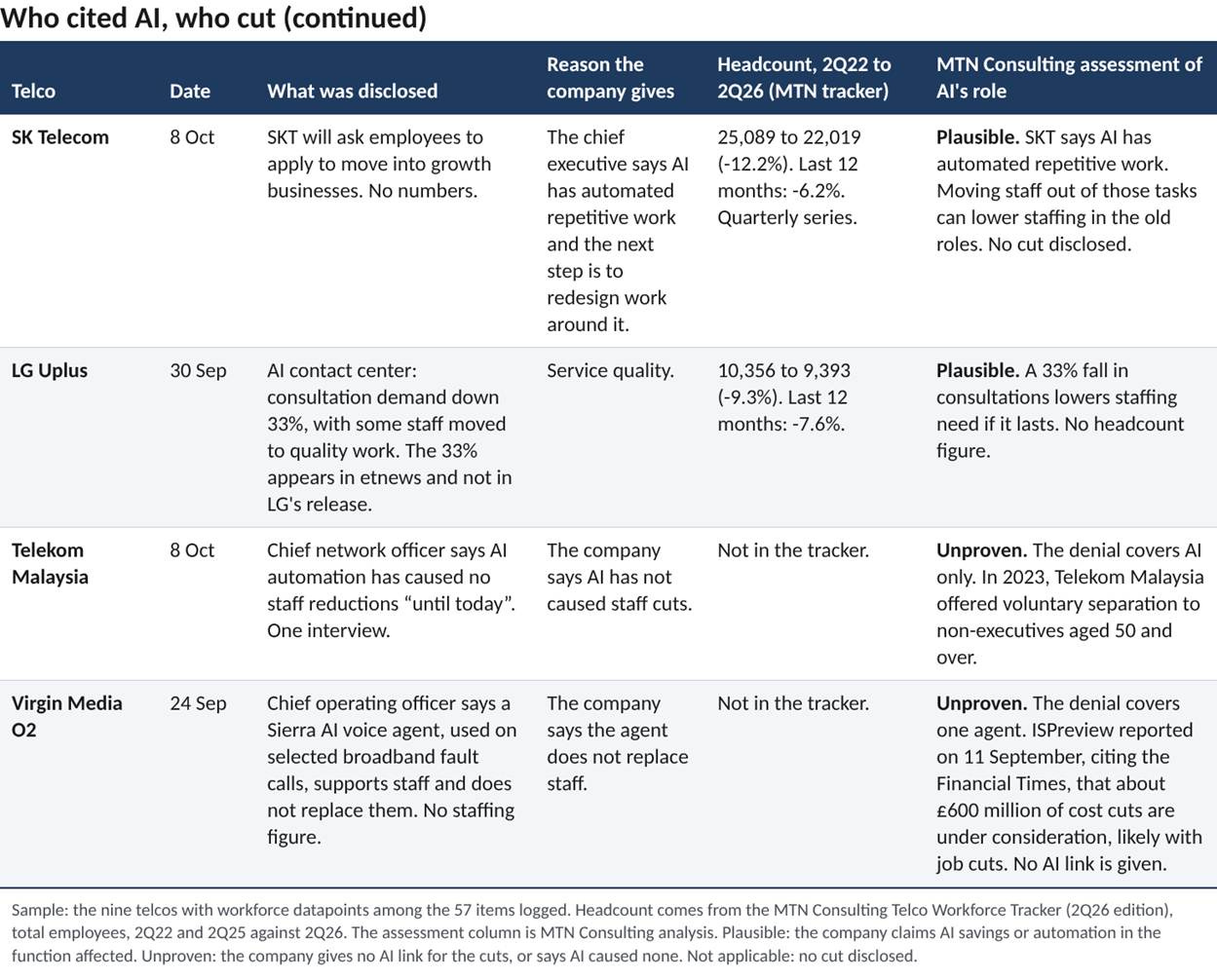
Why it matters: Headcount at all six tracked telcos fell over the four years to 2Q26. The decline across MTN Consulting’s panel began several years before the AI cycle, and the telcos give restructuring, localization and retirement as reasons. A falling headcount therefore does not validate an AI product. Vendors that sell AI as a labor-cost saving should expect buyers to ask for the saving measured in the function the software touches, such as handle time per contact. Company-wide headcount cannot isolate that effect. Investors have one dated test: DT targets €1.1 billion of AI savings in 2027, so its headcount in the affected functions that year tests the claim. Regulators and employee representatives who want to know whether AI drives job cuts should ask each telco for the function affected and the headcount series for it.
Headcount series for each tracked telco in this table are in the Headcount trends and Telco detail tabs of the Telco Workforce Monitor.
Source: https://www.telecomtv.com/content/access-evolution/telef-nica-offloads-another-latam-unit-52823/
Explore the data behind the workforce table in MTN Consulting’s Telco Workforce Monitor, which tracks headcount and labor costs at 145 telcos. Cost: $799 per user seat.
Questions about this post? Contact the author: Matt Walker, Chief Analyst of MTN Consulting (matt@mtn-c.com)