

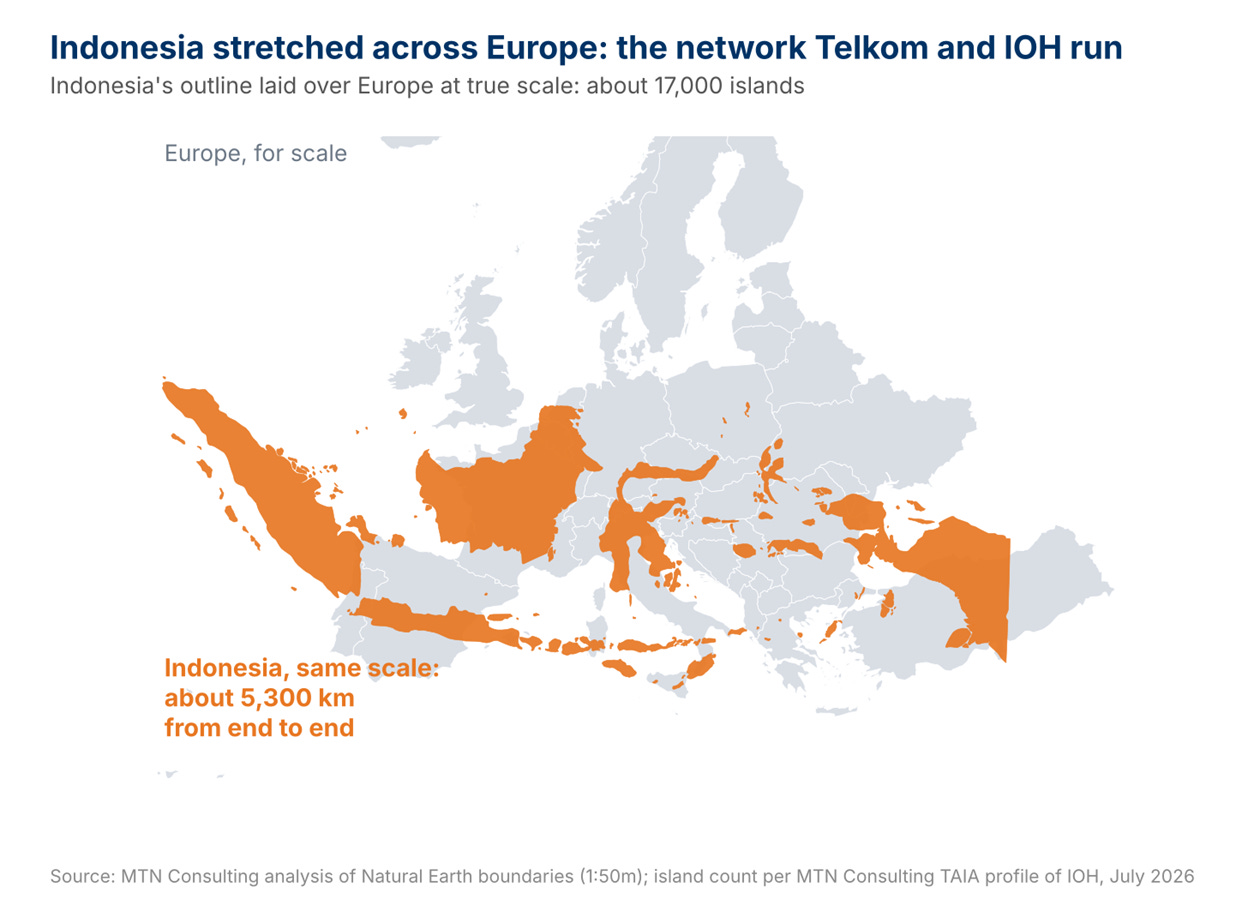
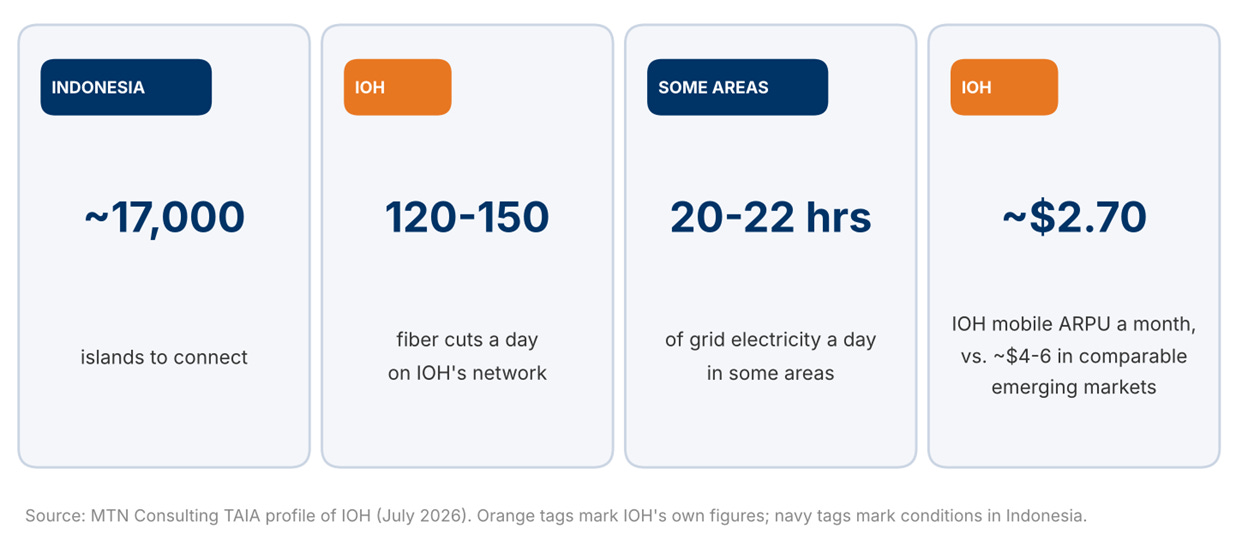
Lay Indonesia over a map of Europe at true scale and it reaches from western France to the Black Sea (see Figure 1). Now put about 17,000 islands inside that outline, add 120 to 150 fiber cuts a day on IOH’s network, and leave some areas with only 20 to 22 hours of grid electricity a day. Then charge IOH’s customers about $2.70 a month.
That’s the job Telkom Indonesia and IOH do every day, and both run AI in live operations. Together they account for 77% of Indonesian telco revenue in 2Q26, and XLSMART, the only other significant player, accounts for 21%, according to MTN Consulting’s Global Telco Market Tracker. MTN Consulting has profiled both for its Telecom AI & Automation (TAIA) research. TAIA scores deployment depth on six criteria, each from 0 to 3, and the profiles of 7 and 9 October 2026 give IOH and Telkom 12 of 18 each.
Indonesia rarely comes up when the industry lists its AI leaders. It should. Both companies stay well above the global telco average on profitability, run leaner than most peers, and have turned TM Forum’s awards stage into a regular stop. The identical scores hide two different stated strategies. IOH calls its strategy AI North Star, with three pillars: an AI-native telco, an AI cloud business, and a nation builder for Indonesia’s digital future (Technology Magazine, 17 March 2026). Telkom Indonesia puts AI inside network modernization in its TLKM30 transformation plan and links its AI units through a platform called AIcosystem (MTN Consulting profile, 9 October 2026). That shows in the revenue evidence. IOH reports AI Cloud revenue of $33 million in 1H26. Telkom has stated AI revenue once, as a figure that Industry.co.id reported as cumulative over seven years.
Figure 1: Indonesia stretched across Europe: the network Telkom and IOH run
A hard country to wire
Indonesia’s geography would test any network engineer. IOH counts 120 to 150 fiber cuts a day nationwide, much of it from ongoing construction, according to MTN Consulting’s July 2026 profile of IOH. In some areas, the power grid runs only 20 to 22 hours a day. As one IOH network executive said, “in some countries you don’t need that much resiliency but here you do.”
Prices don’t leave much room either. IOH’s mobile average revenue per user (ARPU) sits around $2.70 a month, against roughly $4 to $6 in comparable emerging markets, according to the same profile. That leaves less revenue per subscriber to pay for the network than in those markets (see Figure 2).
Figure 2: Two of the four hard conditions, fiber cuts and ARPU, are IOH’s own figures
Both telcos beat the group average margin, but Telkom’s lead fell from 17.2 to 7.4 points
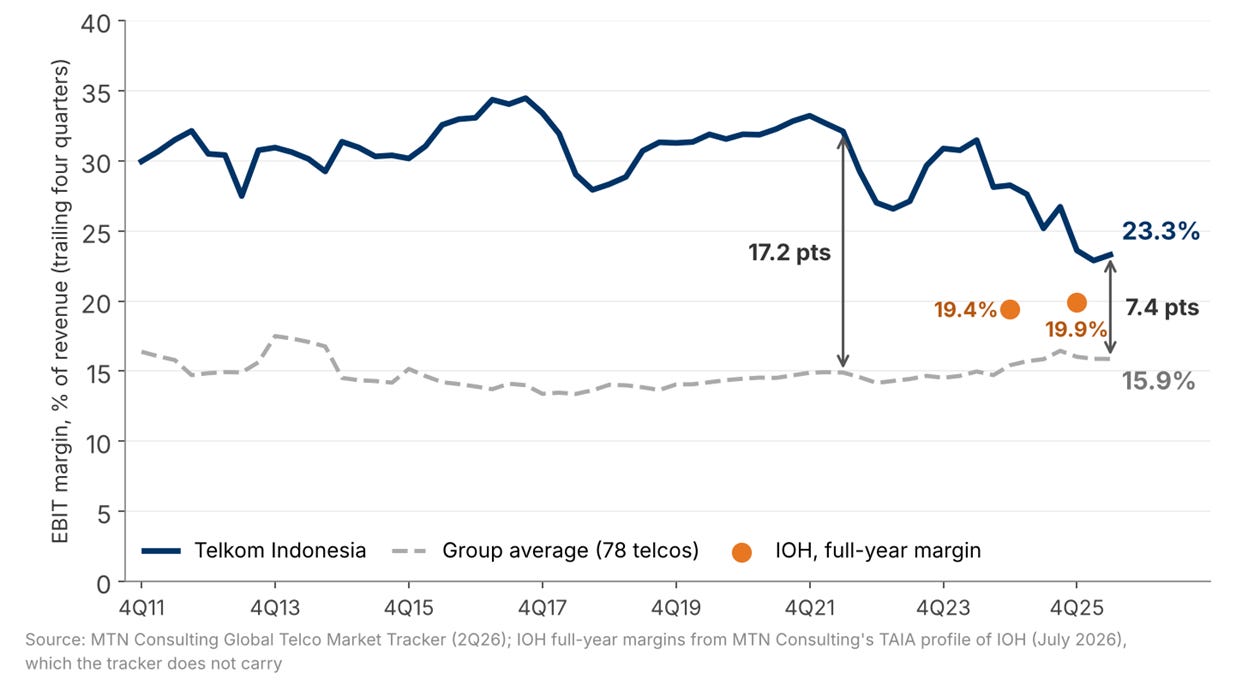
Hard conditions haven’t stopped either company from making money. Telkom’s operating (EBIT) margin was 23.3% in the four quarters to 2Q26, against a group average of 15.9% (78 telcos), according to MTN Consulting’s Global Telco Market Tracker. The group average is total EBIT divided by total revenue. Telkom beat it in every trailing four-quarter period from 4Q11 to 2Q26, but its lead fell from 17.2 points in 2Q22 to 7.4 in 2Q26, with a low of 7.0 in 1Q26. Telkom’s margin fell 8.8 points over that span while the group average rose 1.0. Its earnings before interest, taxes, depreciation and amortization (EBITDA) margin was essentially unchanged over the latest year, at 49.4% in 1H26 against 49.5% in 1H25, according to MTN Consulting’s profile of 9 October 2026. The profile estimates that part of the EBIT margin fall sits in depreciation and amortization. IOH posted a 19.9% EBIT margin in FY2025, up from 19.4% in FY2024, against a group average of 16.0% in calendar 2025, according to MTN Consulting’s July 2026 profile of IOH (see Figure 3).
Figure 3: Telkom’s lead over the group average (78 telcos) fell from 17.2 points to 7.4
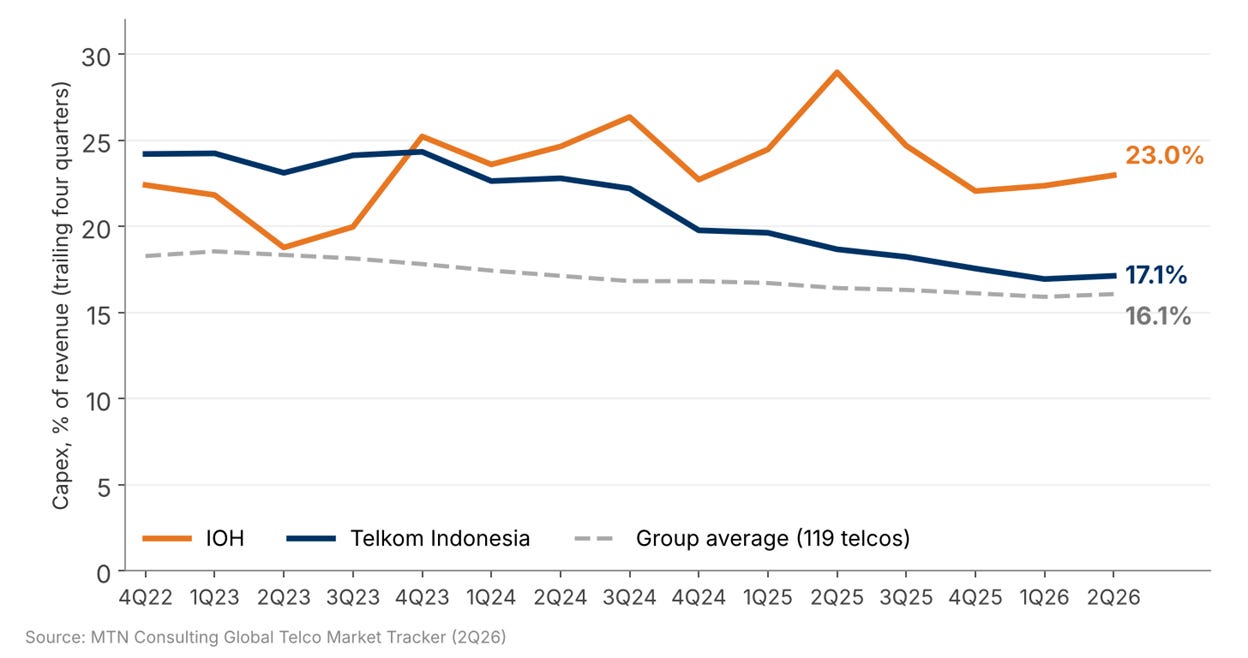
Both also keep building. In each of the 15 quarters from 4Q22 to 2Q26, IOH and Telkom spent a larger share of revenue on capex (capital intensity) than the group average (119 telcos). IOH’s margin over it fell to 0.4 points in 2Q23, and Telkom’s fell to 1.0 points in 1Q26. Telkom spent more than 20% of revenue on capex in every calendar year from 2013 to 2023, between 21.3% in 2021 and 29.1% in 2014. Its capex then fell from 24.2% of revenue in 2022 to 17.1% in the four quarters to 2Q26, against a group average of 16.1%. IOH put 23.0% of its revenue back into the network in the four quarters to 2Q26, down from 28.9% a year earlier (see Figure 4). IOH’s 9 June 2026 release announced a Nokia modernization of its radio network, with mid-band 5G across about 80% of the network over three and a half years.
Figure 4: IOH and Telkom capital intensity consistently above the global average
IOH’s 26.9% headcount rise is at most 9.1% once the 2022 merger is counted, while Telkom cut 16.6%
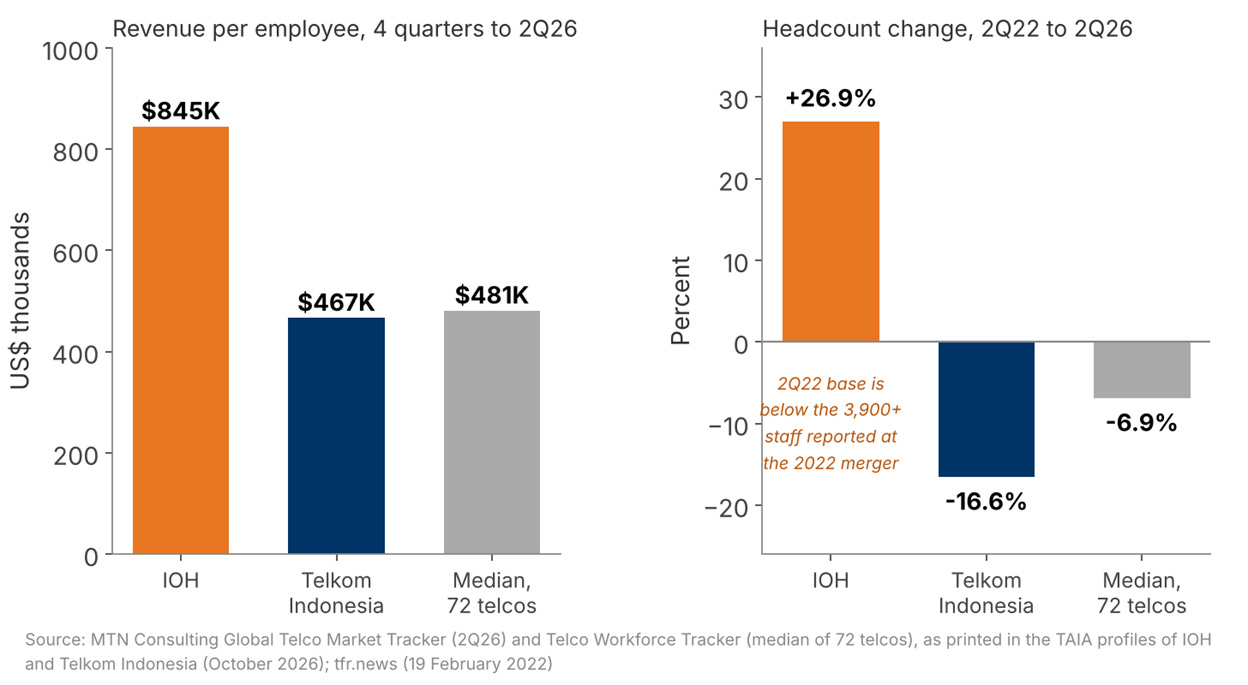
According to MTN Consulting’s Global Telco Market Tracker and Telco Workforce Tracker, IOH’s headcount rose from 3,353 in 2Q22 to 4,256 in 2Q26. Telkom’s fell from 20,897 to 17,438. The median across 72 telcos fell 6.9%. IOH’s rise starts from a base that understates the merged company. The merger of Indosat and Hutchison 3 Indonesia took effect on 4 January 2022 (CK Hutchison release), and the combined company reported more than 3,900 employees (tfr.news, 19 February 2022). From 3,900, the rise to 2Q26 is at most 9.1%. The tracker estimates interim quarters, and its 2022 quarters each add exactly 231 employees, which spreads the merger’s one-time step across the year. From the 2022 year-end count of 3,815 to the 2025 year-end count of 4,202, the rise is 10.1%.
Revenue per employee puts IOH well above the median, and most of its decline since 2Q22 traces to the same headcount base. IOH generated $845,000 of revenue per employee in the four quarters to 2Q26, 1.76 times the 72-telco median of $481,000. That ranks 20th of the 118 telcos in the Global Telco Market Tracker. Telkom, at $467,000, is 3.0% below the median. IOH’s revenue per employee fell 12.2%, from $963,000 in 2Q22 to $845,000 in 2Q26, or 3.2% a year, while the median rose 4.4% a year. Telkom’s fell 0.9% a year, from $484,000 to $467,000. With 3,900 employees in 2Q22 instead of 3,353, IOH’s annualized second-quarter revenue per employee would be $821,000 in 2Q22 and $827,000 in 2Q26 (see Figure 5). The window also includes the 1H26 transfer of management of more than 86,000 km of fiber to a fiber joint venture, FiberCo, agreed on 23 December 2025 (IOH 1H26 release).
Figure 5: IOH’s revenue per employee is 1.76 times the median, but its headcount rise starts from a base below the merged company’s size
Telkom attributes its smaller workforce to organizational streamlining and an Early Retirement Program (ERP), which began in December 2025 with 612 participants, and it has not linked any workforce change to AI (MTN Consulting TAIA profile, 9 October 2026). Both telcos also invest in AI skills. Huawei says its AI operations work with IOH has upskilled more than 400 operations staff. Telkom launched an AI Center of Excellence in September 2025. Its AI Campus partnership with Universitas Muhammadiyah Yogyakarta aims at 113 thousand digital talents, with no stated deadline. Telkom Corporate University signed a memorandum with Universitas Gadjah Mada on 15 November 2025 covering Center of Excellence research in energy and health. Readers who want to compare these workforce trends with 145 other telcos can find them in MTN Consulting’s Telco Workforce Monitor.
Five of eight featured AI results measure network operations, and only one measures revenue
The two TAIA profiles list 38 deployments, 15 at IOH and 23 at Telkom, with statuses that run from trial and announced to in production. Most of the results reported for them come from the telcos themselves or from vendors that sell them technology. Of the eight results featured here, five measure network operations, two measure customer service and sales, and one measures revenue, IOH’s $33 million of AI Cloud revenue in 1H26 (see Figure 6).
