

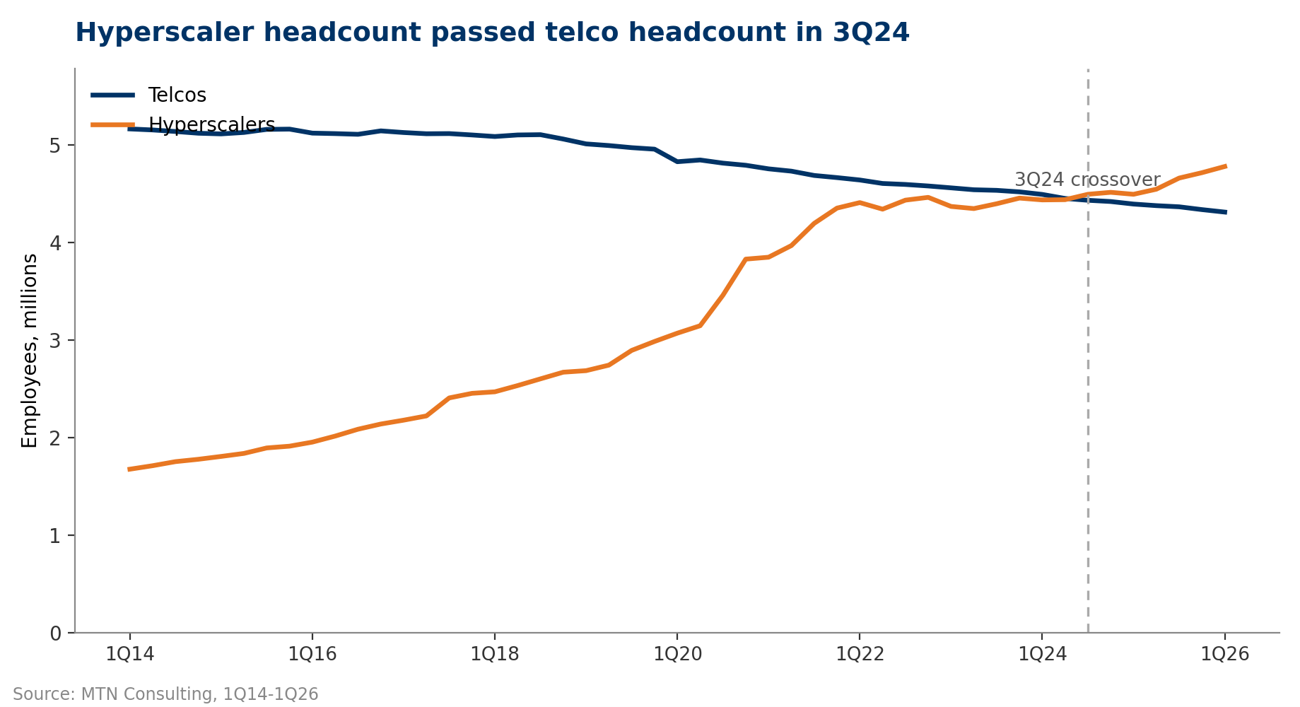
Combined headcount at the hyperscalers, the small group of companies running cloud and AI infrastructure at global scale, passed combined headcount at the telcos in the third quarter of 2024: 4.50 million against 4.43 million. The gap has widened every quarter since. By the first quarter of 2026 it stood at 468,000, with hyperscalers at 4.78 million employees and telcos at 4.31 million. Both totals come from MTN Consulting’s telecom and hyperscale employment tracking. A crossover like this reads easily as engineering talent moving from network operators to cloud and AI infrastructure. The handful of companies on each side that disclose employees by function and specialty make clear it’s more complicated than that.
The two sectors moved in opposite directions for a decade before they crossed. Hyperscaler headcount is up 185% since the first quarter of 2014, from 1.68 million to 4.78 million. Telco headcount is down 16.5% over the same twelve years, from 5.17 million to 4.31 million.
Among hyperscalers, Microsoft discloses the most about its workforce
Telecom business models are relatively homogenous, whereas hyperscalers are all over the place. Some hyperscalers are rooted in ecommerce, some in electronic devices, some in software, some in social media. The sectors have some crossover in technical skills required. For instance, as hyperscalers began investing in subsea cables, they hired talent away from the telecom sector aggressively in order to do so. As AI has exploded, some high-profile telecom execs have migrated; Rakuten’s ex-CTO Tareq Amin, for instance, is now in charge at the Saudi AI giant HUMAIN. But in general they hyperscalers don’t disclose a lot of details on their workforces, relative to telcos.
Microsoft is the only one of Amazon, Microsoft, Alphabet and Meta whose annual filing breaks employees out by function. Of 228,000 employees as of 30 June 2025, Microsoft puts 80,000 (35.1%) in product research and development, 89,000 (39.0%) in operations, covering data centers, product support and consulting, and manufacturing and distribution, 44,000 (19.3%) in sales and marketing, and 15,000 (6.6%) in general and administration (Microsoft Corporation, Form 10-K for the fiscal year ended June 30, 2025, filed July 30, 2025).
Amazon, Alphabet and Meta give only a total headcount in their 10-Ks, and their most recent sustainability reports add no function breakdown either: Amazon at 1.58 million as of 31 December 2025, Alphabet at 190,820 as of 31 December 2025, and Meta at 78,865 as of 31 December 2025. Alphabet’s environmental report does not restate a headcount figure at all, and Meta’s sustainability report discusses supply-chain labor practices rather than its own workforce composition.
Telcos that disclose a split put most employees in sales and customer care, not operations
Vodafone and China Telecom are two telcos that publish a comparable split. Vodafone’s fiscal 2026 annual report puts 61.2% of its 92,988 employees in customer care and administration, 22.3% in selling and distribution, and 16.5% in operations (Vodafone Group Plc, Annual Report FY2026). Two years earlier, Vodafone’s FY2024 annual report showed a similar shape at a larger headcount: operations 16.3%, selling and distribution 23.8%, customer care and administration 59.9% of 96,282 employees. Vodafone’s total headcount fell 3.4% between the two reports, and the customer-care share of what remained rose, not fell.
China Telecom’s 2025 annual report splits 277,911 employees into sales and marketing (37.7%), operations and maintenance (27.5%), management, finance and administration (17.8%), and sci-tech research and product development (17.0%). China Unicom’s 2025 annual report gives shares only: marketing 51.1%, technical 28.9%, management and support 20.6%.
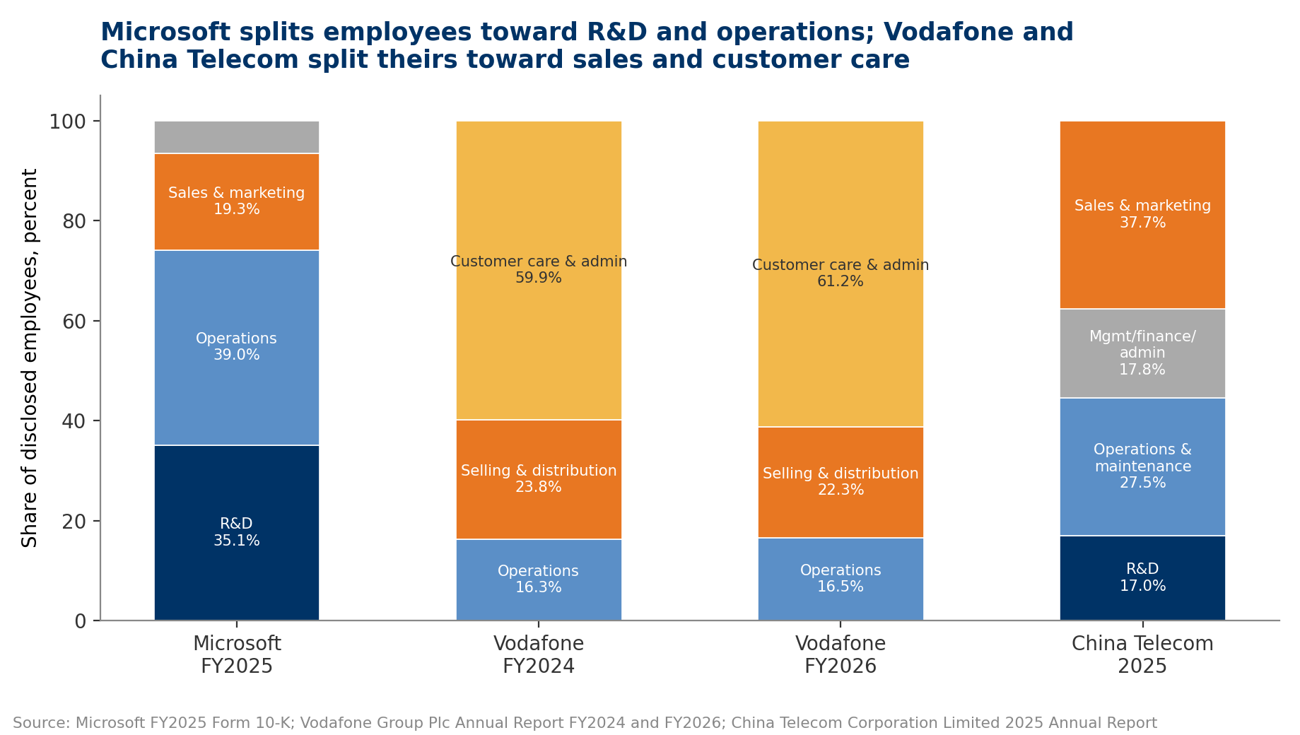
Added together, Vodafone and China Telecom assign 24.7% of their combined 370,899 employees to operations and maintenance. Microsoft alone assigns 35.1% of a much smaller workforce to research and development. The two telcos put the larger share of their disclosed headcount into sales, customer care and administration, the commercial and service side of the business. Microsoft’s largest single category is the most technical one, R&D.
These are individual company disclosures, not industry averages. A breakdown of this kind is rare on both sides. Of the sixteen hyperscalers and telcos checked for this piece, five gave a function-based employee split and two more split by management level instead of by function. Only three of the five, Microsoft, Vodafone and China Telecom, gave shares that reconcile to a full headcount total.
The crossover measures two kinds of organization, not one workforce moving
The disclosed splits point away from a simple story. Vodafone’s own two-point trend puts its shrinking headcount in selling and distribution, not operations: the operations share held roughly flat while the total workforce fell 3.4% between FY2024 and FY2026. Microsoft’s single disclosed snapshot puts 74% of a much smaller headcount in research and development and operations combined. Someone pricing the telco-hyperscaler crossover as network engineers moving into cloud and AI jobs is pricing a headcount total, not the categories the two companies actually report. The telco losses look commercial, and the hyperscaler gains sit in technical work each company already does.
*
Methodology
MTN Consulting tracks employee counts for hyperscalers and telcos inside two separate quarterly research products, one covering telecom company financials and one covering hyperscale company financials, not a single combined tracker. The panel covers 145 telcos and 25 hyperscalers, not all of them still operating independently today. Where one tracked company is absorbed by another, MTN Consulting moves its employees into the acquirer’s line from the deal’s close and holds the absorbed company’s own figure at zero going forward; its historic figures stay in the panel rather than being deleted or carried forward as if it still reported separately. The 468,000-job gap and the twelve-year trend reflect that continuous, absorption-adjusted panel, not a fixed set of companies.
Questions about how to work with MTN Consulting on telecom AI, automation and autonomous-network research? Contact Matt Walker: matt@mtn-c.com | www.mtn-c.com