

[Note to readers: this post was originally published on 15 September 2026 in MTN Consulting’s Silicon Silk Road publication. Now we are transferring coverage of telco AI topics over to this new publication, The Gen AI Telco. To maintain continuity with previous coverage, this post is being re-shared]
*
THE UNMANNED NETWORK | Covering 5 August to 13 September 2026
Bottom Line Up Front
Covering August 5 to September 13, 2026, this issue tracks telecom operators reporting AI as a distinct revenue line rather than an internal cost-cutting tool. It also examines the industry’s first attempts to benchmark “AI-native” operators.
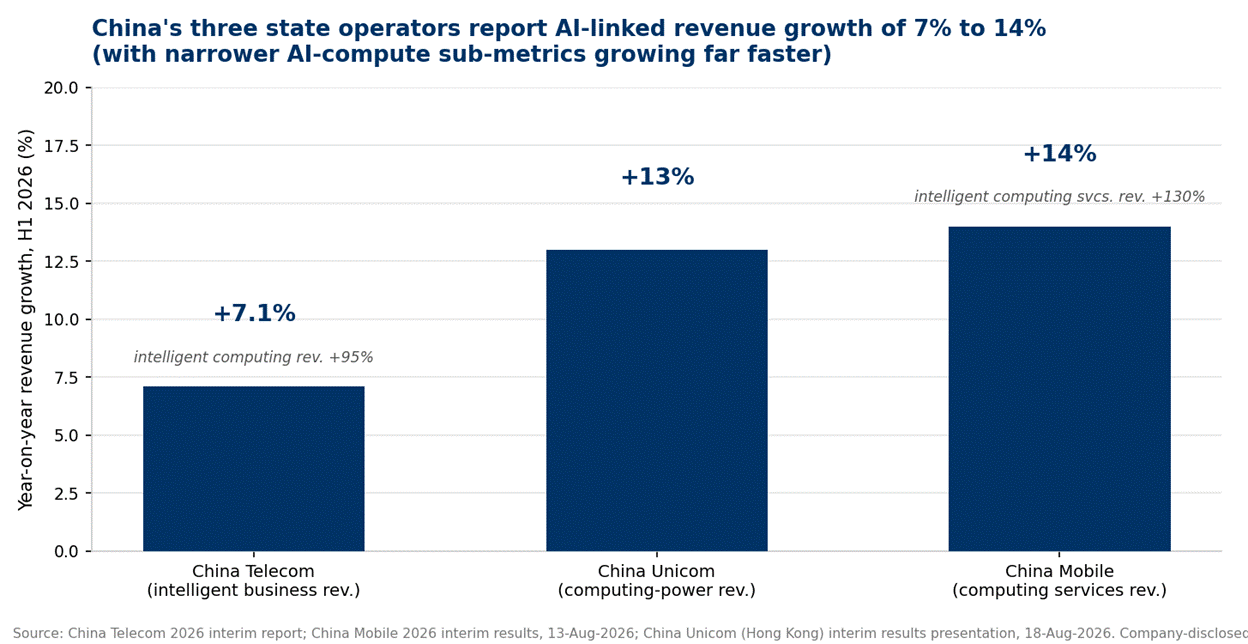
China’s three state-owned operators gave the clearest revenue numbers. China Telecom, China Mobile and China Unicom reported first-half 2026 (1H26) AI-linked computing revenue growth of 13% to 95%, built on token-subscription platforms running on their own state-controlled large language models (LLMs). This is something other telcos could copy. Each of the three runs a marketplace where an enterprise buys access to models by the token - the unit of text a model reads or writes - in the same way it once bought minutes or megabytes. China Telecom’s hosts 142 models and more than 420 industry applications. China Unicom calls its version a “token supermarket.” That turns AI compute from a capital project into a metered product with a per-unit price.
Outside China, SK Telecom reported Q2 2026 AI data center (AIDC) revenue of KRW 136.2 billion ($90 million, +92.5% YoY). In the UAE, e& bundled agentic AI directly into business mobile and broadband tariffs. Modernization cost-cuts continued in parallel: T-Mobile US eliminated over 4,500 roles in 2026 as parent Deutsche Telekom accelerated AI deployments.
Benchmark methodologies also debuted. TelecomTV’s initial AI-Native Telco Index scored 56 operators, placing nine in its top tier: AT&T, China Mobile, Deutsche Telekom, KDDI, NTT/Docomo, Rakuten Mobile, SoftBank, Telefónica, and Verizon. Crucially, of the 20 operators prioritized for AI revenue generation, 15 are in Asia and the Middle East, and 11 are Tier 2 operators ($2B–$10B revenue). Western incumbents lag in top-line commercialization.
Meanwhile, vendors announced over $1 billion in AI-tagged network contracts across Indonesia and Costa Rica. Vendors continue to link AI to new features in press releases announcing contract wins, and we expect this to continue. Whether the AI link is fact or fiction is another question.
Signal vs. Noise
Below is a summary of recent developments in telecom AI, automation and autonomous networks, our view on why they matter, and their implications for operators, vendors and investors.
China’s three state telcos turned AI compute into a reported revenue line, up 13% to 95%
21-Aug-26
China Mobile, China Telecom and China Unicom convert token platforms into a reported revenue line
China’s three state-owned operators now report a working method for billing AI compute the way they once billed mobile data.
China Telecom’s Xingchen TokenHub hosts 142 large language models (LLMs) and more than 420 industry-specific applications. The platform helped drive a 95% jump in intelligent computing revenue and a 7.1% rise in broader intelligent-business revenue to RMB 31.1 billion ($4.6 billion), based on the company’s 1H26 interim report.
China Unicom’s UniAI platform connects more than 200 LLMs through a token-subscription model it calls a “token supermarket.” The platform contributed to a 13% rise in computing-power revenue to RMB 41.9 billion, a figure confirmed in the company’s own 18 August 2026 interim results presentation.
China Mobile’s “token factory” strategy and MoMA platform pushed computing services revenue up 14% to RMB 52.9 billion, with intelligent computing services revenue growing 130% to RMB 5.3 billion. Both figures are confirmed in the company’s own 13 August 2026 interim results.
The models behind these platforms differ by operator. A comparison of China Mobile’s Jiutian, China Telecom’s Xingchen, China Unicom’s Yuanjing and China Electronics’ Guanlan found each model built toward a different enterprise vertical, with no single operator’s LLM dominant across all four (Chinese-language source, summarized).

Why it matters: The most important part of this story is that these three operators are doing it at all. No other national operator group has published comparable AI-token revenue figures. If the token-subscription model holds up as these platforms scale, it is a template other operators elsewhere could copy.
These are the first concrete revenue numbers behind a strategy Chinese operators have discussed since early 2026: selling AI compute like a subscription product rather than treating it as a sunk infrastructure cost. The percentage gains vary by more than seven times across the three operators, which suggests the token-subscription model is still maturing rather than proven at uniform scale. None of the three operators discloses token revenue as its own line item. The figures reported here are company-disclosed segment totals for intelligent computing or computing power, not audited, filed breakouts of AI-token sales specifically.
Sources: https://www.chinatelecom-h.com/en/ir/report/interim2026.pdf | https://www.chinamobileltd.com/en/media/press/p260813.pdf | https://www.chinaunicom.com.hk/en/ir/presentations/pre260818.pdf
Three telcos now disclose AI revenue, and the largest of them is C$700 million
10-Sep-26
Bell Canada, SK Telecom and Indosat put figures on the table, while T-Mobile cut 4,500 jobs in the same window
Three more operators have now put a number on AI revenue.
TelecomTV’s AI-Native Telco Index reports that Bell Canada booked around C$700 million (US$507 million) of AI-powered revenue in 2025, up 60% year on year, against a target of about C$2 billion a year by 2028. BCE’s own results release for 2025 gives a growth rate rather than a full-year figure, and the C$2 billion target is confirmed on its 1Q26 earnings call. SK Telecom’s own 2Q26 results release reports AIDC revenue of KRW 136.2 billion ($90 million), up 92.5%, plus AI business and consumer services revenue of KRW 61.3 billion ($40 million), up 24.5%. Indosat Ooredoo Hutchison reports its AI cloud income as a separate line, at $28 million in 2025 with guidance of around $60 million for 2026, a figure its management frames as the top of a range. Singtel described its own AI progress in a public update without attaching a figure.
In our separate story on TelecomTV’s AI Native Index, we note that 20 of 56 telcos are identified as aiming AI primarily at revenue, 28 as balancing revenue and efficiency, and six as primarily chasing efficiency. Its efficiency examples are KPN, Proximus and Spark New Zealand. KPN is targeting about EUR 100 million a year of operating-cost savings by 2030. Proximus runs AI inside a EUR 180 million efficiency program, and Spark is tracking a reduction in customer loss of up to 30%. In the same window T-Mobile US cut more than 4,500 jobs in 2026 as parent Deutsche Telekom pushes AI-driven modernization.
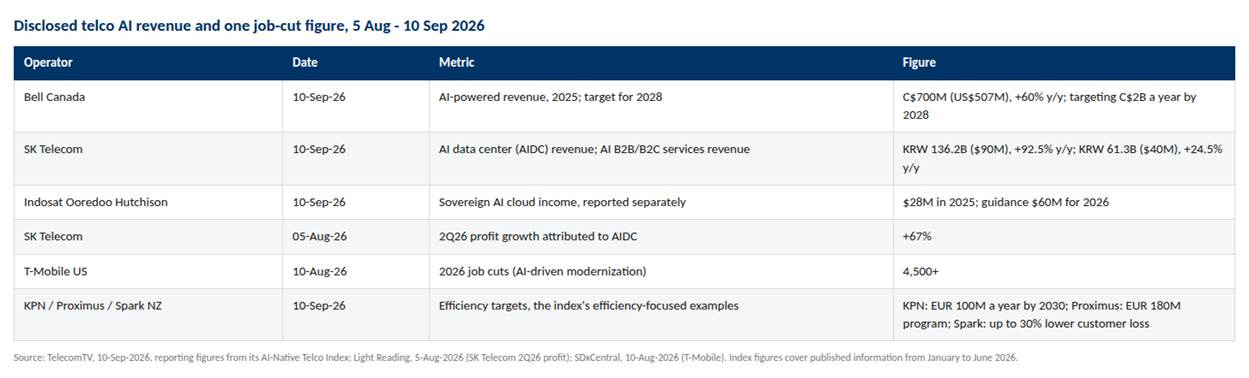
Why it matters: This is the same trend the newsletter’s 5 August issue described, but it now has figures attached. Bell Canada’s C$700 million is the largest AI revenue any telco outside China has disclosed, and it is a low single-digit share of Bell’s total revenue. SK Telecom’s AIDC line is $90 million for the quarter. Indosat’s is $28 million for the year. Set those against the capital going in, including Indosat’s own $800 million Zankore venture and SK Telecom’s multi-gigawatt buildout, and the revenue is one to two orders of magnitude below the spend. The growth rates are real and steep, and the 2028 targets are the thing to hold operators to. Treat the disclosure itself as the signal for now: three operators have decided this line is big enough to report, which is what the previous four quarters lacked.
Sources: https://news.sktelecom.com/en/3218 | https://www.bce.ca/news-and-media/releases/show/bce-reports-2025-q4-and-full-year-results-announces-2026-financial-targets | https://www.telecomtv.com/content/ai/new-report-highlights-telco-focus-on-ai-native-revenue-opportunities-56218/ | https://www.sdxcentral.com/news/t-mobile-us-cut-more-than-4500-jobs-in-2026-as-deutsche-telekom-drives-modernization/ | https://www.telecomtv.com/content/ai/singtel-lays-out-its-ai-progress-ambitions-56141/
A 56-operator index names nine AI-native leaders
07-Sep-26
Two efforts this cycle tried to answer the same question: how do you measure whether an operator is “AI-native,” and who qualifies? TelecomTV assessed 56 operators against published evidence, with a 30 June 2026 cut-off. It published the result as its AI-Native Telco Index on 7 September, then unveiled the 276-page report at its own AI-Native Telco Forum in Düsseldorf over the following two days. It named nine operators as its top archetype, AI Vanguard: AT&T, China Mobile, Deutsche Telekom, KDDI, NTT and NTT Docomo, Rakuten Mobile, SoftBank, Telefonica and Verizon. Five more are Infrastructure Architects and 15 are Strategic Accelerators, across seven archetypes in all, with a single operator left at Transformation Pending.
Separately, FutureNet World asked whether Asia-Pacific operators are ready for fully autonomous networks, a narrower and more concrete question than the global index attempts. That effort found readiness uneven across the region without naming which operators lead or lag.
Turk Telekom did not wait for an index to catch up. It introduced a no-code AI agent platform aimed at level 4-5 network autonomy, the industry’s own top tier for self-managing networks, overseen by the TM Forum. The company positioned the platform partly as reducing dependence on foreign AI technology (Turkish-language source, summarized). While this company was not on TelecomTV’s leader list, it makes a good case for being ranked among the globe’s telco AI leaders.

Why it matters: The new AI native telco index is a meaningful attempt to standardize a term the industry does not yet agree on. The named list of leaders is the useful part: nine operators, heavily weighted to the US, Japan and Germany, with one Chinese operator and none from India, Africa or Latin America. Read that as a map of where published AI evidence exists, not where AI capability exists. Note that TelecomTV runs the index inside its AI-Native Telco Accelerator program, launched in June 2026 with Axiata, Deutsche Telekom, Orange, NTT Docomo, Rakuten Mobile, the GSMA, Wind River and Totogi as founding participants. Three of those founding participants, Deutsche Telekom, NTT Docomo and Rakuten Mobile, are among the nine AI Vanguard.
Sources: https://www.telecomtv.com/content/ai/new-report-identifies-the-ai-native-telco-frontrunners-56184/ | https://www.telecomtv.com/content/ai/ai-native-telcos-prep-major-updates-insights-for-industry-forum-56153/ | https://www.telecomtv.com/content/ai/leading-csps-technology-innovators-and-industry-bodies-back-launch-of-industry-wide-ai-native-telco-accelerator-55746/ | https://www.telecomtv.com/content/ai/anta-builds-momentum-with-seven-new-partners-56105/ | https://futurenetworld.net/are-asia-pacific-telecom-operators-ready-for-fully-autonomous-networks/2026/09/ | https://www.dunya.com/sektorler/bilim-ve-teknoloji/turk-telekomdan-sektore-yon-veren-oncu-hamle-yapay-zeka-ile-tam-otonom-aglar-donemi-haberi-837920
e& puts agentic AI inside a paid business plan, the cycle’s only AI feature with a price attached
18-Aug-26
The UAE operator bundles agentic AI into Business Mobile and Business Pro Internet, paired with domestic sovereign compute
UAE operator e& (Etisalat) began bundling agentic AI directly into its Business Mobile and Business Pro Internet plans. Agentic AI here means automated task execution, workflow management and information retrieval carried out by software agents acting on the customer’s behalf without a human approving each step. The bundle is paired with UAE-based sovereign AI compute, meaning the processing stays on infrastructure inside the country and under its jurisdiction, which matters to government and regulated enterprise buyers. e& disclosed no price premium, no attach rate and no revenue figure for the bundle.
Why it matters: This is the only item this cycle where AI is a billed product attribute rather than an internal efficiency project or a capital commitment. That distinction is the one investors should hold onto: an operator that charges for AI has a demand signal, however small, while an operator that builds AI capacity has a cost and a hypothesis. It’s too early to know what the revenue impact is, though. The test to watch is whether e& or any peer discloses an attach rate or an average revenue per user effect at its next results.
Source: https://www.telecomstechnews.com/news/e-uae-embeds-agentic-ai-into-mobile-and-broadband-products/
Ericsson and Amdocs both win AI-linked contracts, at opposite ends of the network
Aug 2026
A $220 million radio network build in Costa Rica and a billing modernization in Chile, sold on the same automation pitch
Costa Rica’s state utility ICE (Instituto Costarricense de Electricidad) awarded Ericsson a $220 million contract to deploy a standalone 5G network using AI-powered EIAP rApps, automated software components that manage radio access network (RAN) functions. Movistar Chile agreed with Amdocs to modernize its billing and operating systems (BSS/OSS) using automation and AI, disclosing no contract value.

Why it matters: Automation and AI now sell across the whole telco network, not one corner of it. These two contracts sit at opposite ends: Ericsson in the radio access network, Amdocs in billing and operations support. The vendors benefiting are spread just as widely, which is why this newsletter tracks the deals rather than any single supplier. For operators, the practical read is that AI capability is becoming a standard feature of the products they were going to buy anyway, in the RAN and in BSS/OSS alike.
Sources: https://www.ericsson.com/en/press-releases/latin-america/2026/ice-selects-ericsson-to-deploy-costa-ricas-5g-network | https://www.tabulado.net/movistar-chile-acuerda-con-amdocs-modernizar-sus-sistemas-bss-y-oss-con-automatizacion-e-ia/
Indosat and SK Telecom are building AI compute to sell, at 1 GW and a targeted 15 GW
06-Aug-26 (Indosat); Korea buildout dated separately below
Two operators are funding merchant AI capacity rather than buying it, on very different scales
Indonesia’s Indosat Ooredoo Hutchison launched Zankore, a 1 gigawatt (GW) AI infrastructure venture backed by $800 million from parent Ooredoo, aimed at selling AI compute capacity rather than consuming it internally.
South Korea shows what the same strategy looks like several years further along. SK Telecom is targeting 15 GW of AI data center capacity in Korea by 2035, with 5 GW operational by 2029. It has put the buildout into a wholly owned subsidiary, SK Hyper, with a stated KRW 750 billion commitment through 2030. Its Ulsan site is approaching 900 megawatts against an initial 100 megawatts, at a cluster cost SK Group chairman Chey Tae-won put at roughly KRW 7 trillion ($5.2 billion) on 13 September 2026. SK Telecom is an Nvidia Cloud Partner and sells GPU capacity as a service through its Haein cluster. It has not named a third-party compute customer, so its 2Q26 AIDC revenue of KRW 136.2 billion is the only published measure of what the business is currently selling.

Why it matters: Both operators are making the same bet: that enterprises in their home markets will buy AI compute from a domestic telco for sovereignty, latency or procurement reasons rather than from a US- or China-based hyperscaler. SK Telecom’s scale makes it the test case. Its 15 GW by 2035 is a commitment an investor can measure against reality. For vendors, the relevant point is that the buyer for this equipment is now a telco not a hyperscaler. Telcos have different procurement cycles and different regulatory requirements than hyperscalers. Can a telco move at hyperscaler speed? Indosat’s Zankore, at 1 GW and $800 million, is the smaller and more testable version of the same question.
Sources: https://www.fierce-network.com/cloud/indosat-launches-1-gw-ai-infra-play-800m-ooredoo-backing | https://news.sktelecom.com/en/3155 | https://nvidianews.nvidia.com/news/sk-telecom-ai-infrastructure | https://www.koreatimes.co.kr/business/tech-science/20260913/sk-chairman-says-ulsan-ai-data-center-expansion-nearing-900-megawatts
Two bodies moved to standardize the infrastructure under agentic AI, not the AI itself
28-Aug-26
A network standard and an identity framework target the layer under the AI
Two standards-adjacent moves this cycle target the network infrastructure that agentic AI runs on.
The International Telecommunication Union’s telecommunication standardization sector (ITU-T) approved Y.3335, a framework for low-latency, energy-efficient networks intended to support AI-era traffic. The US National Institute of Standards and Technology (NIST) and a group of European telcos converged on digital identity as a required foundation for agentic AI.

Why it matters: Neither of these two moves is itself an AI product. They are the standards and infrastructure layer a vendor or operator needs before it can sell an AI-native service with confidence it will interoperate or authenticate correctly. The identity convergence matters most for operators already selling agentic AI features to consumers or businesses, e& among them: an agent acting on a customer’s behalf without a verifiable identity chain is an impersonation and liability risk. Y.3335 matters most for network equipment vendors and operators building AI-era transport capacity: without a shared benchmark, a vendor’s claim to build low-latency, energy-efficient AI networking has nothing to be measured against.
Sources: https://www.telecomtv.com/content/access-evolution/itu-t-standardises-framework-of-low-latency-and-energy-efficient-networks-to-support-the-ai-era-56130/ | https://www.biometricupdate.com/202608/nist-european-telcos-converge-on-identity-as-foundation-for-agentic-ai
Equinix links automated interconnection to 8 of the top 10 AI model providers
02-Sep-26
Equinix lets a customer describe what it wants in plain language, then automates the order and its execution; its one named customer is an automaker’s IT unit, not a telco, but that may change
Equinix recently launched Fabric One, a service that lets a customer describe a connectivity need through a portal, an API, or a natural-language prompt, and have the system automate the routing, encryption, resiliency and failover that connection requires. This is a big deal: if it works, a customer can simply describe what it wants in an LLM prompt, and Equinix will implement automatically. Equinix cites scale behind the service: more than 10,500 interconnected businesses, roughly 3,000 cloud and IT providers, 8 of the top 10 AI model providers and 9 of the top 10 neoclouds active on its platform. Named integration partners are AWS and Google Cloud, built on open OpenAPI 3.0 interconnect specifications. The service is pre-release: a beta is planned later in 2026, with general availability in 2027.
Equinix’s only named customer for Fabric One is Hyundai AutoEver America, the automaker’s IT services unit, not a network operator. However, across its operations Equinix has many telco customers, colocating equipment and buying interconnection to link their own points of presence, and mobile edge-compute sites, to hyperscaler and AI-provider on-ramps. Automating that provisioning, rather than having network engineers configure each link by hand, is the kind of use a telecom operator could plausibly adopt for its own wholesale and enterprise interconnection products.
Why it matters: This is genuinely new automation, not a rebrand: intent-driven, natural-language provisioning of multi-cloud interconnection did not exist in Equinix’s portfolio before this announcement. The telco use case above is MTN Consulting’s own example, but it seems plausible to us. Even if not, Equinix has proven the technology can serve one enterprise IT buyer, and should be monitored.
Comviva is winning awards and ranking on par with much bigger Amdocs in customer reviews
Jul-26 (Comviva’s own newsletter; underlying claims span Jan-Jul 2026)
A Tech Mahindra unit collects six analyst and awards recognitions in a quarter; independent peer-review data show it rating close to Amdocs, a much larger rival
Comviva is a Tech Mahindra unit selling billing and support systems (BSS), digital engagement and payments platforms to more than 130 telcos across 95-plus countries. Its July 2026 newsletter listed six analyst and awards recognitions in 2Q26, all tied to AI or autonomous operations. Juniper Research named it an Established Leader in digital wallets. Forrester included it among eight vendors worldwide on AI agents in customer relationship management (CRM).
Chief Executive Rajesh Chandiramani said in an interview reported around April 2026 that AI is pushing telecom toward autonomous, zero-touch operations. He set a target to reach roughly INR 4,000 crore in revenue, an estimated $480 million, within three years. He described that as doubling. Comviva’s most recent publicly filed financials, in Tech Mahindra’s FY2023-24 subsidiary annual report, show consolidated total income of INR 13,094 million, roughly $157 million. The target is more than triple that disclosed base, not double it, unless revenue has grown substantially since the last filed figure.
MTN Consulting does not formally rate telecom AI vendors, but the independent data is favorable. Gartner Peer Insights community ratings, aggregated by RFP.wiki, put Comviva at 3.7 out of 5 on 75 reviews for AI in telecom customer and business operations. Amdocs, far larger and better known, rates 3.8 out of 5 on 84 reviews in the same market. Comviva’s last disclosed revenue of $157 million in fiscal 2023-24 is less than 4% of Amdocs’ $4.53 billion in fiscal 2025.
Why it matters: There are at least three notable vendors in the AI-in-BSS space for telcos: Comviva, Amdocs and Netcracker. Comviva’s near-parity with Amdocs on customer review scores, despite being a fraction of its revenue and scale, suggests the technical gap between the two is narrower than their size difference implies. An operator shortlisting vendors should ask each for a named reference deployment with results. Comviva’s smaller BSS competitors do not need Comviva’s scale to compete for the same kind of visibility. An active presence in industry awards and analyst reviews is open to a small vendor with a strong submission, as much as to a large one.
Sources: https://www.comviva.com/resources/newsletter/ | https://completeaitraining.com/news/comviva-targets-revenue-doubling-in-three-years-with-ai/ | https://www.rfp.wiki/artificial-intelligence/ai-csp-customer-business-operations/comviva/amdocs | https://insights.techmahindra.com/investors/tml-subsidiary-annual-report-volume-2-2023-24.pdf
In other news
This cycle (5 Aug-13 Sep 2026)
Rakuten Mobile integrated Anthropic’s Claude into its Rakuten AI for Business platform, one of the first named large-model deployments inside a telco’s own enterprise product. (6 August 2026). Read more
KDDI and AVITA trialed a Gemini-powered humanoid robot with Osaka Metro, one of the few physical-robot deployments tracked this cycle. (28 August 2026). Read more
Zain Kuwait began network testing of real-time AI call translation using a Huawei smartphone, though the announcement discloses no accuracy or latency metrics. (7 August 2026). Read more
Nokia laid out an AI strategy for Africa’s telecom market as the region enters what the company calls its next growth phase. (1 September 2026). Read more
Slovakia’s CETIN Networks selected RADCOM for AI-driven network assurance across its mobile network, a deal RADCOM disclosed by customer count rather than contract value. (12 August 2026). Read more
stc detailed AI partnerships with AMD, Intel, Cisco and AWS spanning data-center capacity, inference compute, edge AI and enterprise adoption, plus tourism and sports use cases. (4 September 2026). Read more
Indonesia’s RAIA Grid launched to build what its backers call a digital superhighway, a data-transport and compute infrastructure initiative distinct from Indosat’s Zankore venture covered above. (26 August 2026). Read more
Newly identified (other 2026 dates, outside this issue’s review window)
Amdocs introduced aOS, an agentic operating system for telecom operations. No operator customer or pilot was named. (3 February 2026). Read more
Alerify and Zadara launched a multi-tenant, NVIDIA-powered sovereign AI cloud for businesses in central Pennsylvania, an enterprise edge deal rather than a telecom operator deployment. (27 January 2026). Read more
Samsung and Nvidia announced further collaboration on AI-native, software-driven radio access network architecture, naming no operator running the technology commercially. (3 March 2026). Read more
Ciena unveiled AI-era optical hardware and agentic assurance features, claiming up to 75% lower power and 85% less space for its hyper-rail photonics. No operator customer was named. (10 March 2026). Read more
Rakuten Mobile and Rakuten Symphony completed a nationwide RAN Intelligent Controller (RIC) deployment with third-party rApp integration, an actual production automation deployment on Rakuten’s own network. (26 February 2026). Read more
Cisco launched Cloud Control, a unified platform for human and AI-agent network management. CEO Chuck Robbins said network capacity needs could triple within three years. No operator customer was named. (2 June 2026). Read more
Red Hat published vendor commentary on the TM Forum’s autonomous-network maturity model, describing most providers as still at level 2 of 5. No operator was named. (4 June 2026). Read more
Marvell announced an AI memory and silicon portfolio for agentic AI inference, claiming 2-3x token throughput gains. It names ‘leading hyperscalers’ generally, not a specific customer. (4 August 2026). Read more
Questions about how to work with MTN Consulting on telecom AI, automation and autonomous-network research? Contact Matt Walker: matt@mtn-c.com | www.mtn-c.com