

Phone bills used to reward homework. A call before 5pm might cost a dollar a minute, and the same call after 5pm might cost nothing. Weekends had their own rates and long distance had others. Texts came in bundles, with a charge for every one over the limit. Customers learned the rules and planned their calls around the clock. New entrants often tried to pick off niche market segments with highly targeted pricing. It was tedious, but the rules were published and every bill could be checked against them.
Yes, it’s true: in the old days of 2G/3G mobile and the PSTN (public switched telephone network), telcos commonly charged for service on a minutes-of-use basis. That was largely abandoned by the early 2010s. Voice calls became effectively free on landlines and mobiles alike, and few people think about their cost now. The meter moved to data, where download caps still ration heavy users. With AI, telcos may come full circle, but this time charge for tokens.
Dropping metered pricing cut the link between how much customers used and how much telcos earned. In China, mobile data traffic grew 17.3% in 2025 while telecom revenue grew 0.7%, according to the Ministry of Industry and Information Technology. Tokens put a meter back on usage.
China Telecom is a standout in the telecom AI world. It is trying to earn money from AI directly instead of just carrying traffic for the companies that do. China Telecom’s core business has stopped growing, as China’s AI providers are growing rapidly. Tokens, the units AI models bill by, give this telco giant a product to sell into that market. The test is whether it can sell them at a profit, because if it can, other telcos have a model worth copying.
China Telecom’s profit fell 14.9% in 1H26 on revenue down 3.9%
In the company’s 1H26 interim results, revenue fell 3.9% to RMB259.0 billion (B) and net profit fell 14.9% to RMB19.59B. The company blamed slowing legacy businesses and a value-added tax (VAT) reclassification, and said core revenue held steady on a comparable basis.
A stalled top line hurts more because the company’s profit margins are razor thin. China Telecom’s margin on earnings before interest and taxes (EBIT) is 6.6%. That is about half the 12.6% average across 49 Asian telcos in MTN Consulting’s Telco Workforce Monitor; see figure, below. Much of China Telecom’s cost base is fixed. Labor takes 25.4% of its operating costs excluding depreciation and amortization, against 21.4% for Asian peers. Headcount has held near 278,000 for five years. With costs that sticky, margin improves mainly through new revenue.
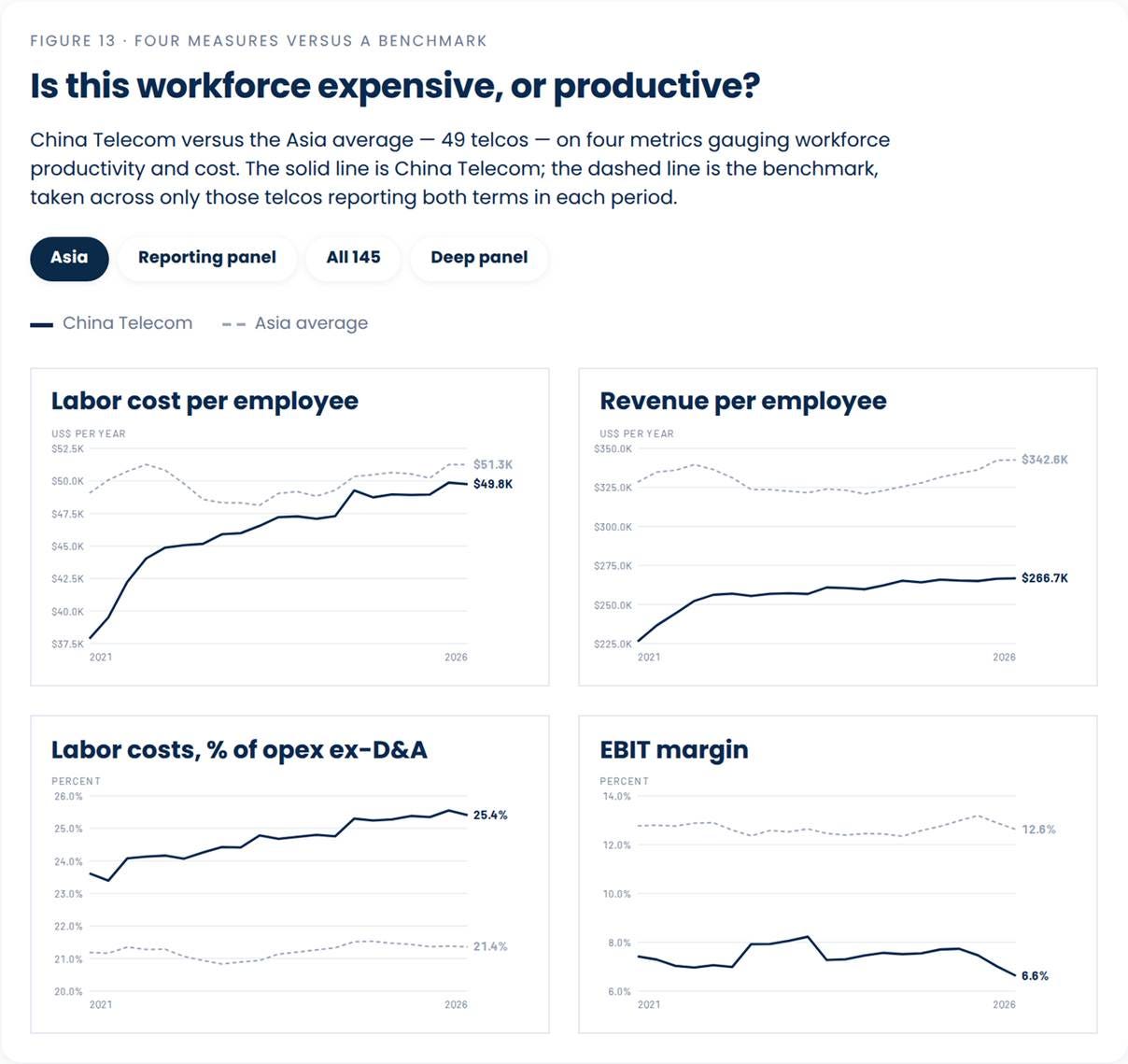
Source: MTN Consulting’s Telco Workforce Monitor, Figure 13, four quarters to 2Q26, US dollars. Solid line: China Telecom. Dashed line: Asia average.
China’s cloud market is growing, but the big cloud providers are growing faster than the telcos. Alibaba’s AI cloud and compute revenue grew 45% in the June quarter, versus just 7.8% growth in 1H26 for China Telecom’s Tianyi Cloud. Alibaba and China Telecom reported the figures in August.
China Telecom is selling AI the way it once sold minutes
To compete for that spending, China Telecom has brought back the meter. It began selling token packages in May, from RMB9.9 a month for 10 million tokens to RMB299.9 for 250 million. Those monthly allowances resemble a mobile data bucket more than a per-minute meter.
The first buyers have come through China Telecom’s own products. Its TeleAgent office assistant has signed up 1.2 million users since July and consumes more than 200 billion tokens a day. China Telecom’s capex budget is supporting this transition. It plans to raise computing capex 26% in 2026 YoY, to 35% of the total, while traditional network spending falls 26%.
The payoff so far is modest. China Telecom groups everything beyond communications services as intelligence revenue. That line grew 7.1% to RMB31.1B in 1H26, 12.8% of core revenue. TeleAgent’s tokens are a sliver of it.
TeleAgent’s token volume would bill under 0.04% of revenue
At China Telecom’s own list prices, TeleAgent’s 200 billion daily tokens would bill RMB46M to RMB194M a year. That is under 0.04% of 2025 revenue.
A skeptic would call that a rounding error, and for now it is one. China’s token market is already large: ByteDance’s Doubao models handled 180 trillion tokens a day in June, Volcano Engine president Tan Dai said. Volume alone still won’t make China Telecom’s version profitable, because token prices keep falling. Model prices have declined roughly tenfold each year, Bain & Company found. A telco reselling other companies’ models may find itself in a race to the bottom.
Beyond raw tokens, China Telecom sells software built on them. It has built 420 industry agents for government, transport and manufacturing customers. An agent is a program that uses AI models to complete a task on its own, rather than answer a single prompt.
Other telcos can copy the pricing more easily than the position
For other telcos, copying the pricing is the easy part. China Mobile and China Unicom have already followed China Telecom into token sales. Copying the position outside China is harder. A European or US telco would sell tokens against Amazon Bedrock, Microsoft Azure AI Foundry and Google Vertex AI. Each already offers enterprises a menu of leading models.
Whoever sells them, tokens reverse a decade of telco pricing. Telcos spent the 2010s teaching customers to stop counting minutes. China Telecom now wants them to count tokens.
This could be a plus. The old calling plans were a chore, but anyone could check a bill against a published rate. AI pricing today offers no such check. As a frequent user of AI Cowork tools, I support any change to bring greater transparency to AI pricing. It would help consumers struggling to understand their bills, and AI providers as well. Ultimately it’s more effective to lock in users based on loyalty and high satisfaction rates, rather than just the fear of having to start work over with another provider.
*
Methodology
Margin, labor and headcount figures come from the MTN Consulting Telco Workforce Monitor, 2Q26 edition, in US dollars over the four quarters to 2Q26. The Asia benchmark covers 49 telcos. Renminbi figures are company disclosures as reported by the named outlets. The TeleAgent billing range is our estimate: 200 billion tokens a day for a year, priced at the lowest and highest per-token rates across China Telecom’s published packages.
About Gen AI Telco
The Gen AI Telco Substack is published by MTN Consulting LLC. Founded in 2017, MTN Consulting is a boutique advisory firm focused on telecom and hyperscale markets. We work with companies, investors, and policymakers on AI transition topics. Clients, soon-to-be clients, and journalists, feel free to contact us with any questions: Chief Analyst Matt Walker.