

Telcos have struggled to grow revenue for more than a decade. This raises a recurring question: Can a telco perform better under a conglomerate parent—either by accelerating growth through synergies or by leveraging a shared cost base?
Reliance Industries’ Jio is often cited as proof of the conglomerate model. Reliance frequently highlights these synergies on earnings calls. Jio’s operational efficiency reflects clear cross-pollination from its parent group, alongside an aggressive approach to recruiting international talent that sets it apart from legacy carriers.
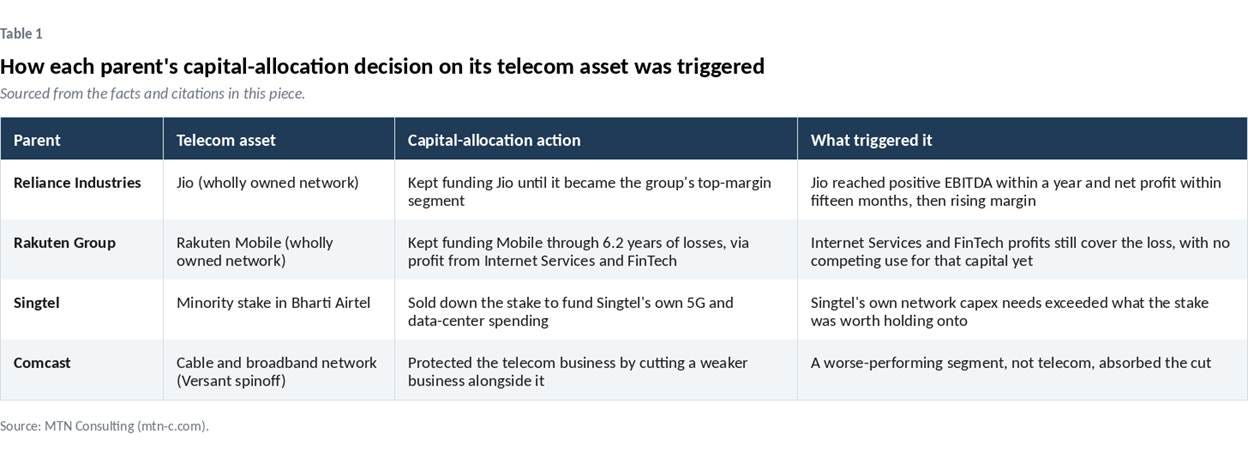
Jio got funded for its initial launch for very practical reasons: nothing else in Reliance’s portfolio offered a better use for the money. Eventually it became Reliance’s best-performing segment. Rakuten Group is hoping for the same result with Rakuten Mobile. Six years later, though, the logic has produced the opposite result, as Rakuten continues to report losses.
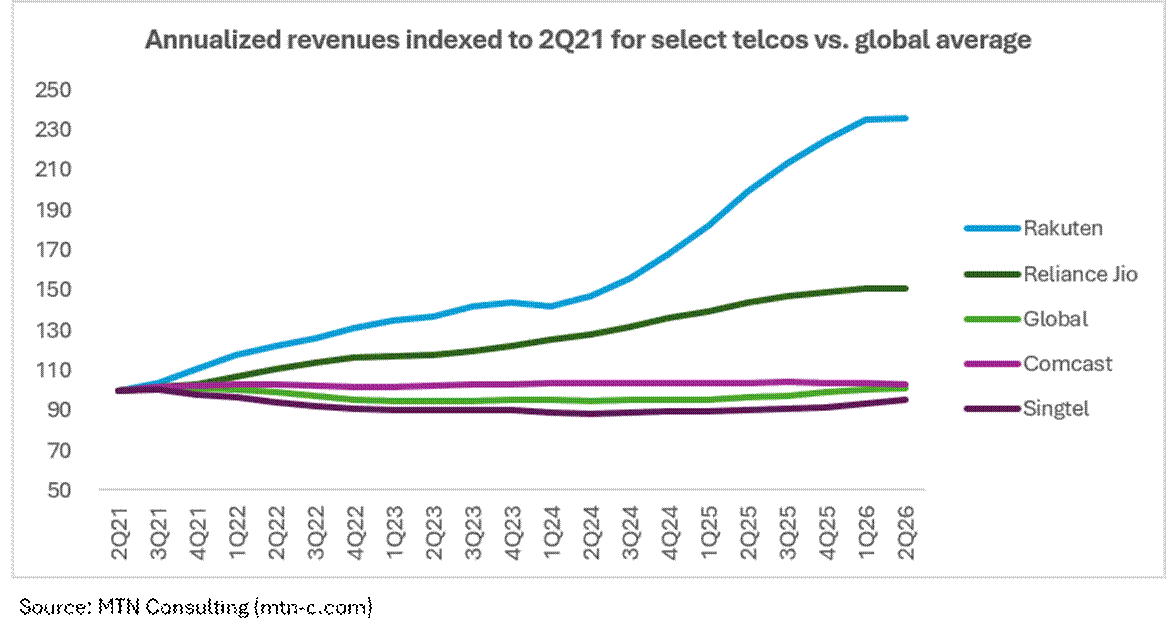
Both Jio and Rakuten are considered greenfield operators, as they built most of their network from scratch. There are also some large telcos that are part of larger corporate groups, including through direct ownership (Comcast), and minority equity stakes (Singtel).
Jio reached positive earnings before interest, tax, depreciation and amortization (EBITDA) within a year of launch
Reliance Jio Infocomm launched commercial service on 5 September 2016. By the quarter ended 30 September 2017, twelve months later, Jio reported EBITDA of 14.43 billion rupees. EBITDA excludes depreciation, the dominant cost for a mobile network still being built, so a positive figure alone does not show the business covering its full costs. Reliance’s presentation for that quarter also reported positive earnings before interest and tax, the profit measure after depreciation. Three months later, in the quarter ended 31 December 2017, Jio reported its first net profit after tax: 5.04 billion rupees, fifteen months after launch. Jio has stayed profitable since and now runs the highest margin of any Reliance segment: a 51.9% EBITDA margin in fiscal 2026, against 8.3% for Retail and 9.1% for oil-to-chemicals.
Rakuten Mobile is 6.2 years past launch and still lost 33.1 billion yen last quarter
Rakuten Mobile launched full commercial service on 8 April 2020. In the quarter ended 30 June 2026, 74 months later, Rakuten’s Mobile segment still posted a non-GAAP operating loss of 33.1 billion yen. Table 2 shows how that loss has moved since Rakuten Mobile’s first full fiscal year.
The Mobile segment’s full-year non-GAAP operating loss has narrowed every year since fiscal 2022. Table 2 breaks out the figures.
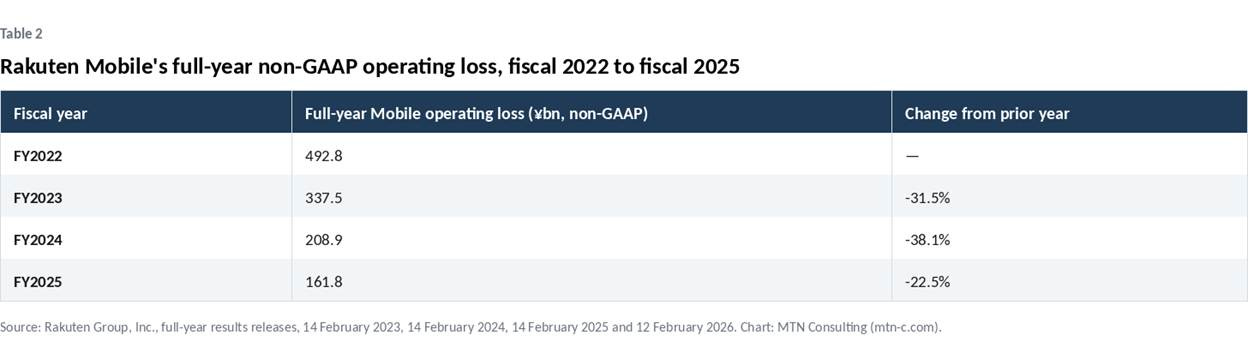
Estimate, our own calculation: the pace of improvement slowed in fiscal 2025. The loss fell 22.5%, versus 38.1% the year before, a smaller improvement in percentage and in absolute yen (47.1 billion yen, against 128.6 billion the year before). Fiscal 2025 was also the first year Mobile reported a full-year EBITDA profit, 12.9 billion yen, since Rakuten entered the mobile business.
Rakuten’s restated year-on-year figures differ from what it first reported by 14 to 23 billion yen a year. This analysis uses the figures as first reported.
Rakuten entered a mature market under different structural conditions
India had poor mobile data coverage and weak carrier loyalty when Jio launched in 2016, the conditions a price disruptor needs. Japan’s three carriers already gave customers good service and strong loyalty when Rakuten launched in 2020. Japan’s regulator had also already forced tariff cuts of roughly 40% and dropped cancellation fees before Rakuten arrived, narrowing the price gap Rakuten needed to undercut.
Rakuten also launched with a thinner spectrum allocation than the incumbents held. It had to build far more base stations than planned to cover the gaps, which raised network costs for years.
Rakuten’s own case for staying in is not a mobile profitability forecast. Its January 2026 strategy update frames continued investment around “ecosystem synergy,” mobile driving use of Rakuten’s e-commerce and financial services. Rakuten has not published a yen figure for that synergy in any release checked for this piece.
Two other Rakuten businesses are funding Mobile’s continued loss
Rakuten Group posted its first quarterly net profit in six years in the quarter ended 30 June 2026: 7.7 billion yen, an improvement of 58.7 billion yen year on year. Internet Services, mainly e-commerce, contributed 23.1 billion yen in non-GAAP operating income, up 68.6% year on year, and FinTech contributed 69.2 billion yen, up 60.1%. Mobile’s 33.1 billion yen loss was the only segment in the red. On the same earnings call, Rakuten’s finance chief described Mobile’s funding as self-funding, no longer requiring outside financing, according to a transcript of the call published by Investing.com. Rakuten has not disclosed a target date for Mobile to reach a full-year operating profit.
Singtel monetized a minority stake to fund core infrastructure
Singtel and Comcast apply the same logic to telecom assets they do not run outright. Singtel holds a different kind of telecom exposure: minority equity stakes in independently run, separately listed sister telcos rather than a wholly owned network. Its effective stake in India’s Bharti Airtel fell from 31.4% in 2022 to 26.9% as of 30 June 2026, a cut of 4.5 percentage points, funded by a series of stake sales that Singtel has used to pay for its own 5G and data-center spending. Bharti Airtel is not underperforming. Singtel is redirecting capital away from a minority telecom holding toward its own core network spending, a different mechanism from Rakuten funding Mobile’s losses, but the same underlying behavior: a diversified owner moving capital toward whichever part of the portfolio it judges will earn the best return next, not toward telecom by default.
Comcast shed media assets to isolate its broadband and wireless core
Comcast took a structural approach: on January 2, 2026, it completed the spin-off of Versant Media Group ($7\text{ billion}$ in FY2024 revenue, declining at 6.9% CAGR since FY2018). Comcast retained its core broadband and wireless assets (Xfinity, Comcast Business, Sky) alongside NBCUniversal streaming and parks. Management did not exit telecom; it carved out declining media assets to protect core connectivity margins.
The conglomerate is managing telecom as a capital allocation, not a strategic commitment
Four diversified owners, four different-looking decisions, one common mechanism. Reliance kept funding Jio because it paid off inside sixteen months and has kept paying off since. Rakuten keeps funding Mobile because two other segments can currently cover the loss, not because Mobile has hit Jio’s timeline. Singtel is pulling capital out of a telecom stake that is performing fine, because its own network spending currently ranks higher. Comcast protected its telecom business by removing a worse-performing business from next to it, not by protecting telecom for its own sake.
None of these four decisions was made because telecom is strategically special to a diversified parent. Each was made the way a portfolio manager reallocates between assets: fund the one with the fastest credible path to return, trim the one competing with a higher-priority use of capital, and cut the one dragging on the rest, whether or not it happens to be the telecom line.
Two of these bets added a new network to a market that already had enough capacity. Jio and Rakuten Mobile both built from scratch and competed on price, forcing incumbents to answer with margin cuts of their own. Singtel and Comcast never added capacity. They moved capital around telecom assets that already existed. That distinction is about to be tested again.
SpaceX is choosing whether to become a fourth U.S. carrier or buy one of the three
SpaceX already has spectrum and a paying mobile business. It bought $17 billion of spectrum from EchoStar in September 2025 to expand Starlink’s Direct to Cell service. Semafor reported on 29 July 2026 that SpaceX is now seeking more spectrum suited to dense urban areas, by acquisition or at auction. Starlink’s mobile business is projected to reach $15 billion in revenue this year.
Musk said in September 2025 that buying a carrier outright was “not out of the question” (Semafor). Wolfe Research analyst Peter Supino has gone further, arguing publicly that SpaceX should buy an existing carrier, preferably T-Mobile, rather than build an independent fourth network (Fierce Network). His reasoning: a new price-competing entrant would cut industry profitability more than owning an existing carrier would, for SpaceX included.
I now weight SpaceX’s odds of getting a carrier deal past this FCC up, not down, on politics. Musk is not Paramount, buying access for the first time with a one-off settlement. He was the single largest donor of the 2024 election, spending at least $277 million to help elect Trump, and ran DOGE, the Department of Government Efficiency, from its creation on 20 January 2025 until he stepped down that May. A public feud followed in mid-2025, over Trump’s tax-and-spending bill and Musk’s comments about Jeffrey Epstein. Both men have been rebuilding the relationship since: Musk joined Trump’s Beijing trip in May 2026 and had pledged at least $100 million to Republican midterm campaigns by August.
SpaceX’s strategic choice—building a fourth standalone network versus acquiring an existing operator—will determine the market impact. Building a fourth network would mirror Jio’s entry in India, diluting market margins across all operators. Buying an incumbent maintains industry capacity while transferring ownership.
Investors evaluating telecom entry must price Jio’s timeline, not its mythology
Reliance is repeatedly cited as proof that a conglomerate can fund a loss-making mobile network into a profit center. The number usually left out is how fast that happened: twelve months to positive EBITDA, fifteen months to net profit. Rakuten Mobile, funded on the same premise by the same kind of diversified parent, is 74 months past launch and has not yet posted a full-year operating profit. Its loss is narrowing, but more slowly than it was two years ago, and Rakuten has not said when, or whether, that changes.
None of these four cases shows an ownership structure that creates telecom growth. Building a new network grew revenue by cutting competitor margins, not by expanding the market. If SpaceX buys an existing carrier, it replaces an owner without adding revenue. If it builds a fourth network, it adds a competitor, and incumbents take the same margin hit Reliance’s rivals took.
About Gen AI Telco
The Gen AI Telco Substack is published by MTN Consulting LLC. Founded in 2017, MTN Consulting is a boutique advisory firm focused on telecom and hyperscale markets. We work with companies, investors, and policymakers on AI transition topics. Clients, soon-to-be clients, and journalists, feel free to contact us with any questions: Chief Analyst Matt Walker.